


V. Santharam / CC BY 2.5
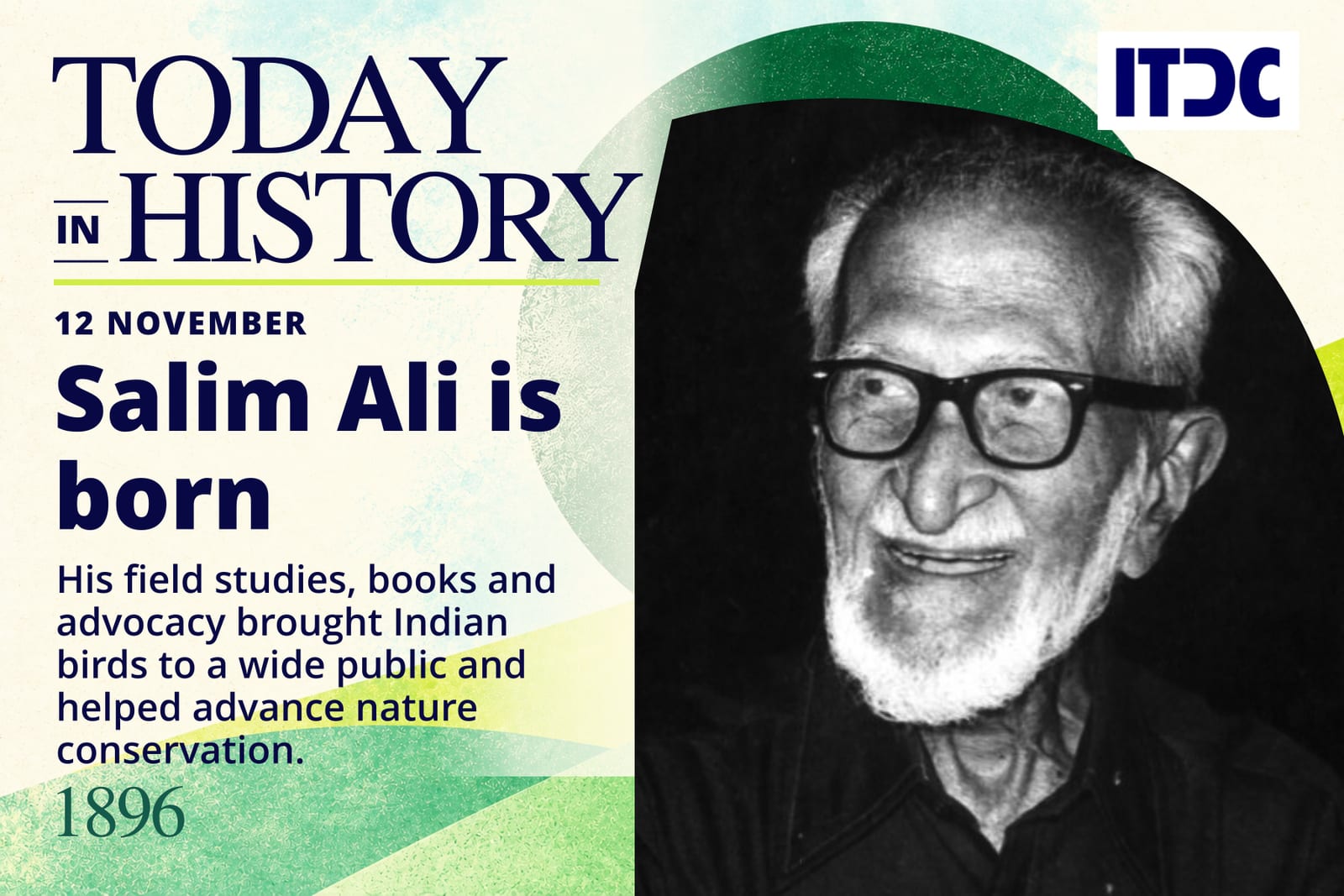
A bird becomes easier to notice when someone gives us the means to recognise it. Salim Ali, born in Bombay, now Mumbai, on 12 November 1896, spent much of his life supplying those means. His work joined systematic observation with an unusual ability to make birds interesting to people outside specialist circles.
The Bombay Natural History Society recounts a formative childhood visit prompted by a sparrow with an unfamiliar yellow throat patch. Ali had shot the bird and wanted to identify it. W. S. Millard showed him the Society’s collections and lent him books. The episode belongs to a period when collecting specimens played a prominent role in natural history; its lasting importance was the question it encouraged him to ask.
Ali’s professional development was not confined to a classroom. He worked as a guide lecturer at the natural history section of Bombay’s Prince of Wales Museum and later trained with ornithologist Erwin Stresemann in Berlin. Field observation became the centre of his working life.
He investigated behaviour as well as names. His study of Baya Weavers at Kihim examined breeding habits, showing how sustained attention to familiar birds could produce scientific questions. A bird list was a beginning, not the whole purpose of ornithology.
Making knowledge travel
Surveys took him through many parts of India, including Hyderabad, Travancore and Cochin, Central India and Kutch. Such work helped document where birds occurred and how they lived. Repeated observation supplied a basis for comparing regions and recognising differences in habitat.
The Book of Indian Birds, first published in 1941, carried that knowledge to a broader readership. Its importance was not simply that it contained information, but that it helped readers connect a description with a bird they might actually encounter. Identification could turn an ordinary walk into an exercise in attention.
Ali also used radio. A later collection brings together thirty-five broadcasts delivered between 1941 and 1985, revealing a communicator interested in wildlife and conservation beyond birds alone. Spoken explanation could reach listeners who might never consult a scientific journal.
His public influence rested on this relationship between detailed research and accessible communication. Affection for birds became more useful when joined to knowledge of their behaviour and surroundings.
Remembering Ali’s birthday need not begin with a distant or spectacular species. It can begin with the bird outside a window: what is it, what is it doing and what does it need? His work helped make those modest questions a route into a much larger understanding of the natural world.




