


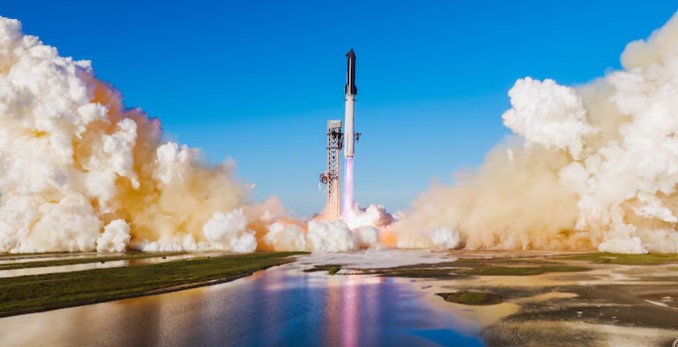
American aerospace company SpaceX faced an unexpected setback during its ambitious Starship Flight 15 mission, but the launch could still become a historic milestone for the company. Launched from Starbase in Texas on November 13, 2026, the massive rocket lifted off successfully and began its planned journey into space. However, an attempt to catch the Super Heavy booster using the launch tower’s mechanical arms had to be called off.
Instead of returning the booster to the launch tower, SpaceX directed it towards a controlled landing in the Gulf of Mexico. However, the booster exploded before reaching the water. As a result, the mission could not achieve its initial objective of recovering and catching both rocket stages.
26 Satellites Successfully Deployed in Orbit
The upper stage, Starship Ship 42, delivered a more successful performance. It reached low Earth orbit and successfully deployed all 26 Starlink V3 satellites.
This is being regarded as Starship’s second successful orbital flight. The newly deployed satellites are expected to strengthen the Starlink network, improve its capacity and support faster internet connectivity.
Focus Shifts to the Return of the Upper Stage
SpaceX now faces another major challenge: bringing the Starship upper stage safely back to Earth and catching it with the launch tower’s mechanical arms. The company has planned the return attempt for November 14.
If successful, this would mark the first-ever recovery of the Starship upper stage through a mechanical catch system at the launch tower.
The technology is designed to make both stages of the rocket reusable. SpaceX hopes this approach will eventually reduce the cost of space missions, enable more frequent launches and transform the economics of space transportation.
Hashtags: #ScienceTechnology #Bhopal #Setback #Starship #Flight #But #Spacex #Could #Still #SetbackForStarshipFlight



