


CNN Central News & Network-ITDC India Epress/ITDC News Bhopal: Signs of a 50-km-long tunnel on the Moon, could become a natural bunker
CNN Central News and Network – ITDC India ePress | ITDC News, Bhopal: New Delhi. Scientists searching for a safe place for humans to stay on the Moon for long periods have found signs of a vast natural structure beneath its surface. An analysis of radar data obtained from Japan’s space agency JAXA’s Kaguya orbiter has indicated the possibility of a lava tube about 50 kilometres long in the Moon’s Marius Hills region. According to scientists, if this underground structure exists as expected and is stable, it could be useful as a natural shelter for future human missions to the Moon.
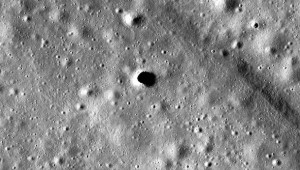
How was the sign of the tunnel found? In 2009, Japan’s Kaguya orbiter observed a large pit on the lunar surface in the Marius Hills region. It was named the “Marius Hills Hole.” The pit is about 50 metres wide and 50 metres deep. Scientists suggested that it could be an open entrance to a vast underground cave.
Researchers later studied data received from the Lunar Radar Sounder installed on the orbiter. The radar signals showed patterns consistent with the possibility of empty space beneath the surface. Gravity-related data from the surrounding area also supported this estimate. The findings of this research were published in the scientific journal Geophysical Research Letters in 2017.
The lava tube may have formed billions of years ago. According to scientists, such tunnels could have been created by flowing lava during ancient volcanic activity on the Moon. When the upper layer of lava cooled and solidified while the hot lava inside continued to flow onward, it left behind a long hollow structure. These are called lava tubes.
The structure found in the Marius Hills region is being considered a possible underground cave of this kind. Further investigation is needed to determine its actual internal condition, size and the strength of its roof.
Why is this discovery important for astronauts? The lunar surface poses challenges such as radiation from space, impacts from micrometeorites and sharp temperature changes between day and night. A natural tunnel located underground could provide some protection from these risks. Its walls and roof could help protect future equipment and possible habitats from the external environment. However, the presence of water or ice in this tunnel has not been confirmed. Similarly, it has also not been proved that there is enough safe space there for humans to live.
NASA will also carry out further investigation. According to a report published in October 2026, NASA has advanced the development of scientific instruments called GIMLI to confirm the possible underground cave in the Marius Hills region. Under the proposed plan, the area could be studied through radar, gravimeter and seismic instruments using a rover to be sent in 2031. The objective of this mission is to determine the presence of underground empty space, its dimensions and the stability of its roof.
Conclusion: Signs of a 50-kilometre-long underground lava tube on the Moon are significant for space research. But it is still too early to call it a ready natural bunker or a safe place for a human settlement. Only after direct investigation will scientists be able to determine how useful this structure may prove for future lunar missions.
Hashtags: #ScienceTechnology #Bhopal #Moon #Tunnel #LavaTube #MariusHills #50Km #Signs #NaturalBunker #JAXA



