


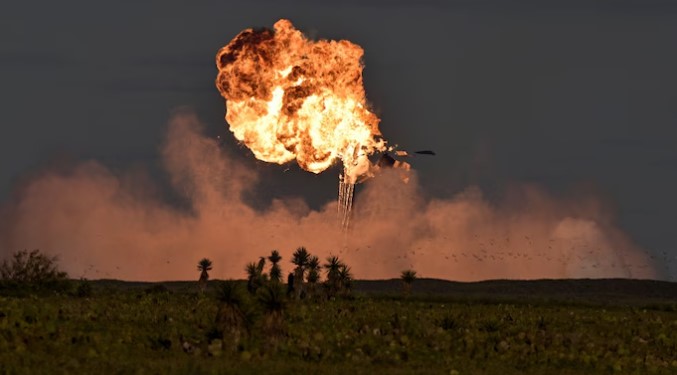
Elon Musk’s aerospace company SpaceX suffered a major setback during its Starship Flight 15 mission after an attempt to catch the Super Heavy booster at the launch tower was called off due to a technical issue. The booster was subsequently redirected towards the Gulf of Mexico, where it exploded shortly before reaching the water. The incident prevented the company from achieving its ambitious goal of safely recovering both stages of the rocket.
Starship successfully lifted off from SpaceX’s Starbase facility in Texas on November 13. Approximately two-and-a-half minutes after launch, the Super Heavy booster separated from the upper stage. The original plan was to guide the booster back to the launch site and catch it using the launch tower’s massive mechanical arms.
However, a technical problem emerged during its return, forcing SpaceX to abandon the recovery attempt. The booster was then directed towards a controlled landing in the Gulf of Mexico, but it exploded before reaching the sea.
Upper Stage Completes Its Mission Successfully
Despite the booster failure, the Starship upper stage successfully reached its designated orbit. It also deployed 26 Starlink V3 satellites as planned, marking an important achievement for the mission.
SpaceX is now focused on the safe return of the upper stage and an attempt to catch it using the launch tower’s mechanical arms.
Challenge of Building a Fully Reusable Rocket
SpaceX aims to recover and reuse both stages of Starship, a technology that could significantly reduce the cost of space missions and enable more frequent launches.
The failure of the Super Heavy booster recovery attempt is expected to prompt a technical investigation by the company. The findings could help SpaceX address the challenges involved in developing a fully reusable launch system.
Hashtags: #ScienceTechnology #Bhopal #Spacex #Super #Heavy #Booster #Explodes #During #Return #SpaceXSuperHeavyBooster



