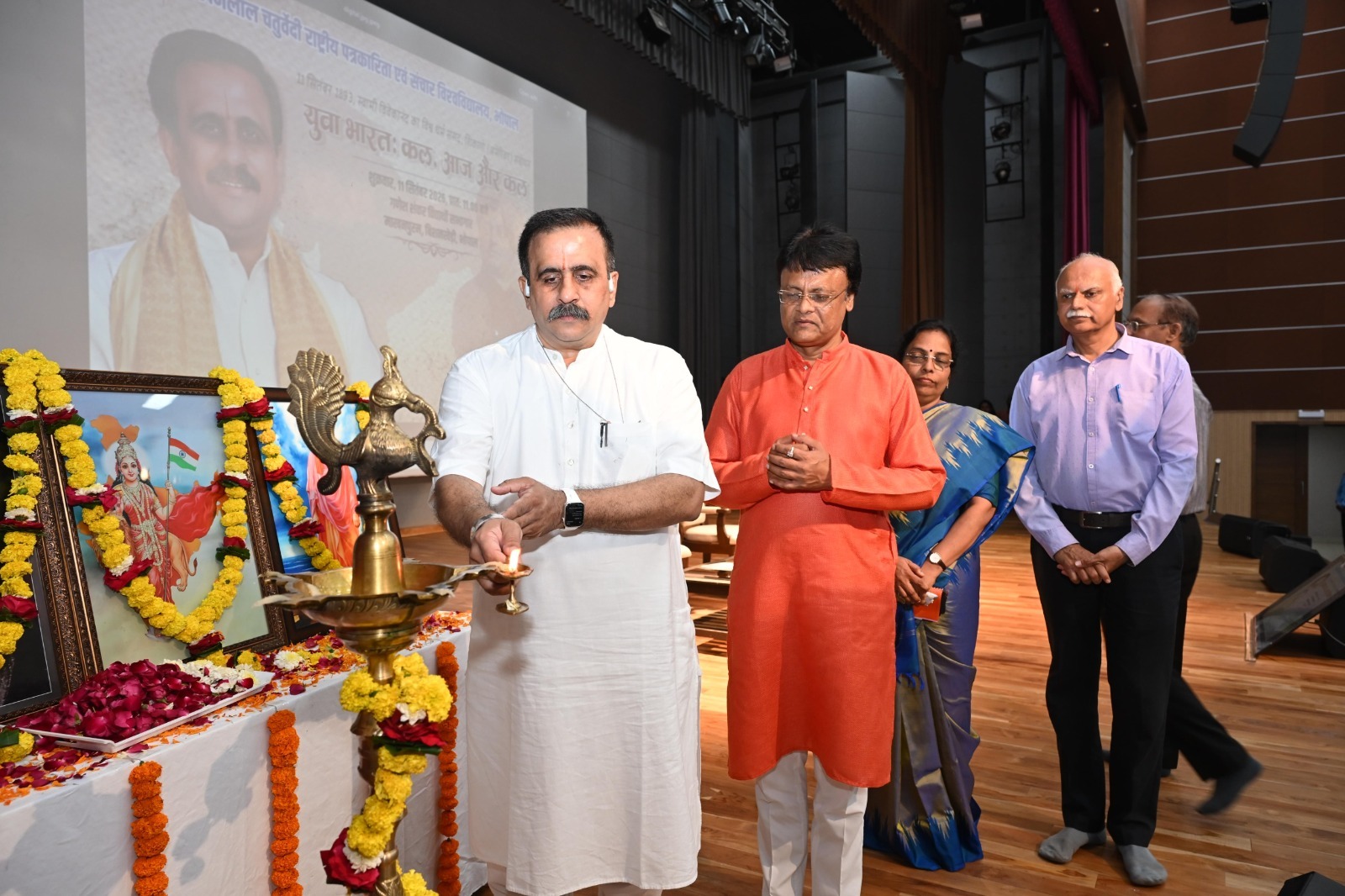
CNN Central News & Network-ITDC India Epress/ITDC News Bhopal: Who are you, where have you come from, and what is the purpose of your life? The one who faces these questions and searches for answers is young. That person is great. Swami Vivekananda, Mahatma Gandhi, Netaji Subhas Chandra Bose, Mirabai and APJ Abdul Kalam asked these questions, and their lives changed. Every young person should ask these questions while looking in the mirror. Eminent speaker Mukul Kanitkar expressed these views.
A special lecture was organised at Makhanlal Chaturvedi National University of Journalism and Communication in memory of Swami Vivekananda’s Chicago address. The programme was chaired by Vice-Chancellor Vijay Manohar Tiwari. At the end, Kanitkar also responded to students’ queries.
Speaking on Young India, Mukul Kanitkar said that when Swami Vivekananda addressed the Parliament of Religions in Chicago, the applause continued for a long time. The reason, he said, was not merely that he addressed the audience as “brothers and sisters”, but the emotion behind that expression. Before his Chicago address, Swami Vivekananda had endured immense hardship for one and a half months after reaching America. He had swallowed the poison of insult and contempt. Even after suffering so much hardship and humiliation, when Swami Vivekananda got the platform to speak, he made no complaint. With affection, he said, “My dear American sisters and brothers.” This emotional expression left an impact on everyone present there. In a way, Swami Vivekananda transmitted spiritual energy into everyone’s minds.
Kanitkar said that those who are powerless complain. The young provide solutions. Youth means being full of courage. Swami Vivekananda remains a source of inspiration for young people even today because he never complained. He said Swami Vivekananda’s impact was such that he delivered seven speeches at the World Parliament of Religions. Later, research was conducted on his speeches. Mary Louise Burke, who later came to be known as Sister Gargi, carried out the world’s most in-depth and authentic research on Swami Vivekananda’s work in Western countries, especially America and England.
She wrote an extensive six-volume book series titled “Swami Vivekananda in the West: New Discoveries”. For this research, she travelled across America and Europe for many years. She traced the cities, newspaper archives and families where Swamiji had stayed. She discovered many letters, lectures and memoirs of Swamiji that had been lost to history.
Kanitkar said, “Sister Nivedita says that September 11, 1893, is the day of the rebirth of Hinduism.” He said Swami Vivekananda changed the world’s narrow view of Hinduism. He said that in one of his speeches in Madras, Swami Vivekananda asked three questions: Do you consider this Bharat Mata your mother from the heart? Have you used your mind to think of solutions to problems? And are you ready to serve with your own hands for those solutions?
Kanitkar said that if we consider India our mother, why do we make it unclean, why do we throw garbage here and there, and why do we pollute the land by using plastic? In his address, he placed such burning questions before the youth for reflection.
Mukul Kanitkar appealed to young people to ensure, while buying any goods, that they purchase products made in India or in friendly countries. Defining modernity, he said modernity applies to tools and technology, not to culture. Culture continues through continuity. Culture and modernity move together. We should preserve our culture while being modern in our thinking.
Referring to how good news has the capacity to inspire society, he narrated an incident from the life of former President and great scientist APJ Abdul Kalam and said, “APJ Abdul Kalam says that when…”
Hashtags: #MadhyaPradesh #Bhopal #MCU #YoungIndia #MukulKanitkar #SwamiVivekananda #MakhanlalChaturvediUniversity #VijayManoharTiwari #SpecialLectureOnYoung #MadhyaPradeshState