


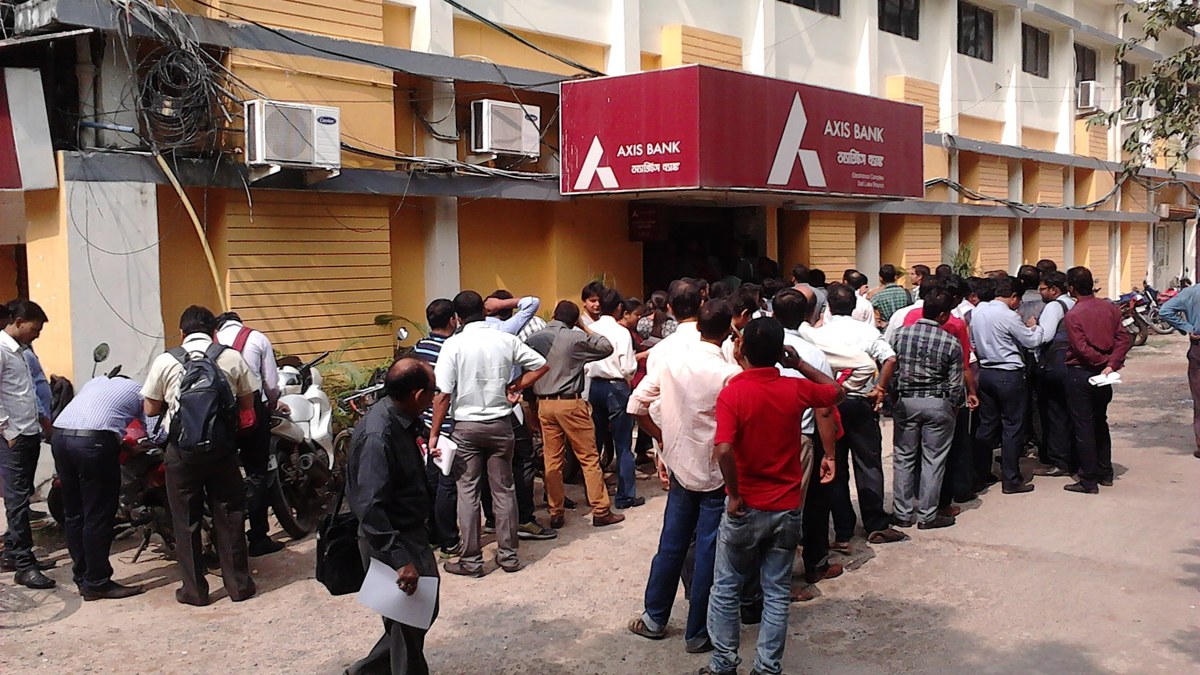
Biswarup Ganguly / Wikimedia Commons (CC BY 3.0). Cropped.
Ten years ago today, on 8 November 2016, Prime Minister Narendra Modi announced that ₹500 and ₹1,000 notes would no longer be legal tender, pulling about 86% of the cash in circulation out of use overnight. A decade on, official data show Indians have taken to digital payments without giving up cash.
Currency in circulation stood at ₹17.77 lakh crore when the move was announced, according to Finance Ministry figures cited by Business Standard. RBI weekly data put it at ₹43.16 lakh crore on 23 October 2026. Measured against the size of the economy, cash fell from 12.1% of GDP in 2015–16 to 8.7% the next year, then climbed back to roughly 12% in 2025–26, close to where it started.
Digital payments grew on a far bigger scale. UPI, launched in 2016, handled 1.78 crore transactions in 2016–17 and about 24,162 crore in 2025–26, worth roughly ₹314 lakh crore, according to NPCI data.
The two trends are not a contradiction. A 2023 RBI study found that people increasingly use digital channels to pay while holding cash as a precaution and a store of value.
Other stated aims have a weaker record. RBI figures show 99.3% of the withdrawn notes, by value, came back into the banking system. The Hindu, reviewing RBI data, reported on Sunday that detection of counterfeit notes, particularly ₹500 notes, has risen.
For households and small traders who stood in bank queues that November, the lasting change is in how they pay. Cash now sits alongside UPI rather than being replaced by it.
Hashtags: #TheBiggerPicture #Demonetisation #DigitalPayments #Economy #बड़ीतस्वीर #नोटबंदी #डिजिटलभुगतान #अर्थव्यवस्था #NoteBan #CurrencyInCirculation




