


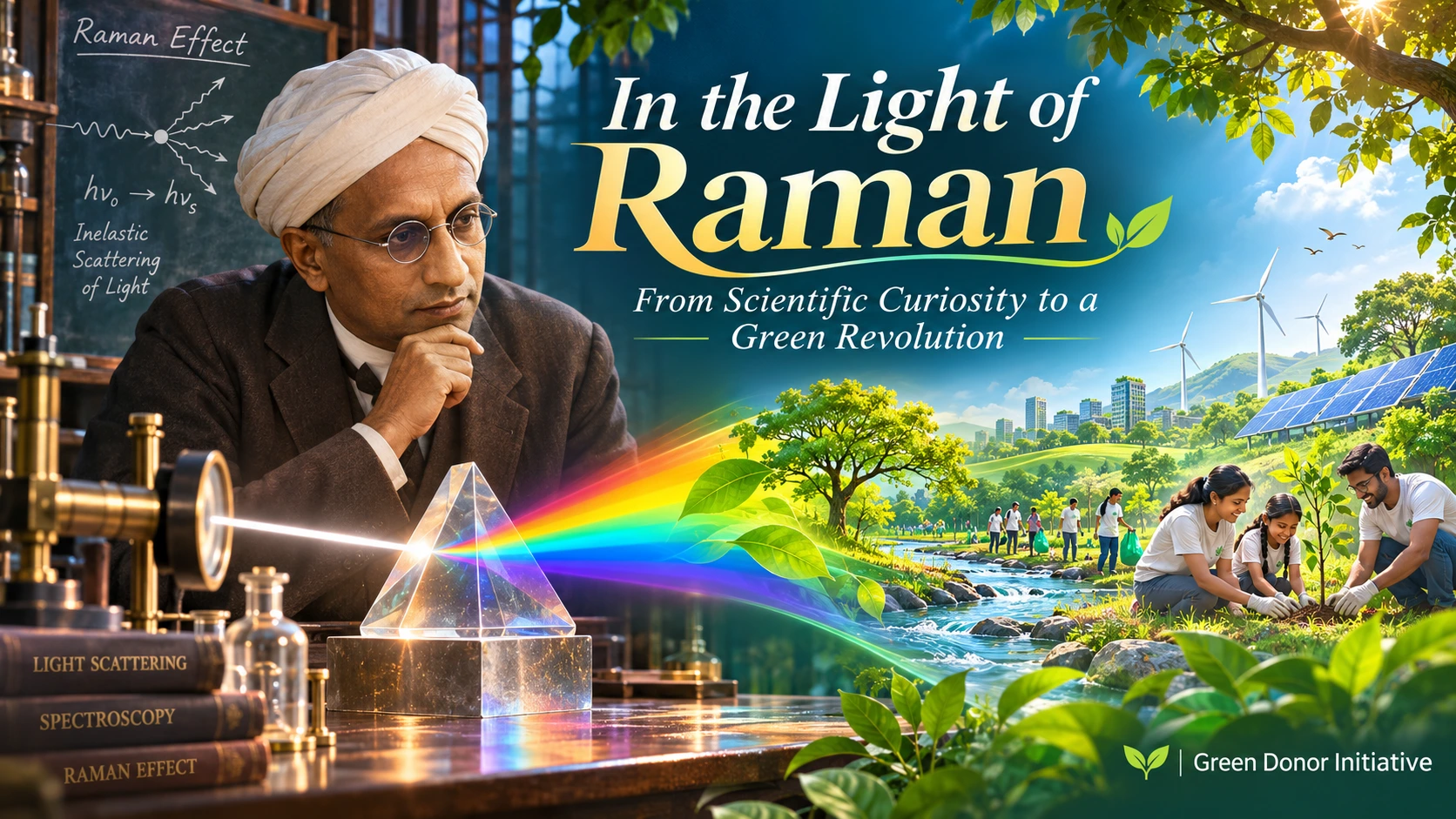
Raman Effect Centenary: Green Donor’s Pledge for Nature
From the Raman Effect to the Green Donor Effect: When Science Becomes the Guardian of Nature
Celebrating a century of scientific brilliance and embracing a new era of environmental responsibility. Discover how Green Donor carries forward Dr. C.V. Raman’s legacy to inspire a sustainable future.
Introduction: A Historic Turning Point
Certain dates in the history of human civilisation shine ever brighter rather than fading beneath the dust of time. The morning of February 28, 1928, is inscribed in golden letters in the history of Indian science, when the eminent physicist Dr. Chandrasekhara Venkata Raman (Dr. C.V. Raman), working in a modest laboratory in Kolkata, unravelled a remarkable mystery associated with the scattering of light, known today across the world as the Raman Effect.
Today, as we mark the completion of 99 years of this revolutionary discovery and stand at the threshold of its centenary year, it is not merely a moment to celebrate India’s intellectual brilliance. It is also an occasion to reflect on whether we have used science to protect the very nature from which this extraordinary discovery originated.
While the world grapples with serious environmental challenges such as global warming, climate change, toxic air and diminishing green cover, visionary initiatives in India, such as Green Donor, are building a unique bridge between Dr. C.V. Raman’s scientific legacy and environmental conservation. In the centenary year of the Raman Effect, this convergence of science and nature emerges as a new ray of hope for humanity.
A Revolutionary Discovery Born from Curiosity About Nature
The story of the Raman Effect did not begin with mechanical calculations behind closed laboratory doors. Rather, it was the outcome of Dr. Raman’s profound love for nature and his keen powers of observation.
In 1921, while returning to India from London, Dr. Raman was captivated by the deep and mesmerising blue colour of the Mediterranean Sea. At the time, Lord Rayleigh’s explanation that the sea appeared blue merely because of the reflection of the sky was widely accepted. However, Dr. Raman’s inquisitive and nature-loving mind was not satisfied with this explanation. Using a small Nicol prism, he examined the seawater and observed that water molecules themselves scattered sunlight.
Upon returning to India, he pursued intensive research on the subject with his colleagues for nearly seven years. Finally, on February 28, 1928, he demonstrated that when a beam of light passes through a transparent medium—whether solid, liquid or gas—a portion of it is scattered. A tiny fraction of this scattered light undergoes a change in its wavelength and energy, depending upon the internal structure of the molecules of the medium.
In simple terms, the molecules of different substances interact with light in distinctive ways, creating what may be described as a molecular fingerprint.
For this groundbreaking discovery, Dr. Raman was awarded the Nobel Prize in Physics in 1930, becoming the first Asian and the first non-white scientist to receive this prestigious honour in the field of science.
Revolutionary Applications of the Raman Effect in Environmental Conservation
As we reflect upon the 99-year legacy of the Raman Effect, we discover that the modern technology derived from this principle—Raman Spectroscopy—has emerged as a powerful and precise scientific tool for protecting the Earth’s environment and combating pollution.
While detecting environmental contaminants previously required complex chemical procedures and hours of investigation, Raman-based technologies can now enable rapid and precise identification of pollutants without destroying the sample under examination.
Some of its major and transformative environmental applications include:
1. Detection of Microplastic Pollution
Today, our oceans, rivers, soil and even human blood have been found to contain microscopic plastic particles, including microplastics and nanoplastics. These particles can be so small that identifying them through conventional microscopy becomes extremely difficult.
Using modern Raman microspectroscopy, scientists are identifying plastic particles smaller than one micrometre in water, fish, sea salt and air.
The technology not only detects the presence of plastic but also identifies its specific type, such as polyethylene, PVC or polystyrene, thereby helping researchers trace and address the sources of pollution.
2. Real-Time Monitoring of Air Pollution and Toxic Gases
Rapid industrialisation and vehicular emissions have severely affected urban air quality.
Raman LIDAR technology enables remote atmospheric monitoring and assists researchers in studying gases, particulate matter, water vapour and aerosols.
Understanding the behaviour of atmospheric water vapour and aerosols across different altitudes contributes to more accurate weather forecasting and improved assessment of the effects of climate change.
3. Detection of Chemical and Biological Contamination in Water Sources
Surface-Enhanced Raman Spectroscopy (SERS) has emerged as a promising technology for detecting industrial contaminants, pesticides and heavy metals in rivers and groundwater.
Specialised Raman-based sensing techniques and portable instruments can assist in identifying trace contaminants, including arsenic, lead and harmful agricultural pesticides.
Such applications hold considerable potential for ensuring drinking water safety and preventing waterborne diseases.
4. Soil Health and Sustainable Agriculture
The excessive use of chemical fertilisers is progressively degrading soil fertility.
Raman spectroscopy is increasingly being explored for analysing organic matter, moisture, nitrogen-related compounds and other nutrients present in soil.
These scientific assessments can help farmers understand the nutritional requirements of different sections of their agricultural fields. Consequently, the unnecessary use of chemical fertilisers can be reduced, soil pollution can be controlled and sustainable agricultural practices can be encouraged.
5. Development of Clean Energy and Green Hydrogen
To reduce dependence on fossil fuels such as coal and petroleum, the world is increasingly turning towards green hydrogen and advanced lithium-ion batteries.
Raman spectroscopy plays an important role in the development, analysis and optimisation of these clean energy technologies.
Scientists use Raman-based techniques to study chemical reactions within fuel cells, batteries and solar energy materials, helping improve their efficiency, durability and sustainability.
6. Wildlife Conservation and Prevention of Illegal Trafficking
The conservation of wildlife and rare plant species is essential for maintaining ecological balance.
Raman technology can be used for the non-destructive examination and identification of ivory, rare timber such as sandalwood, and medicinal plants.
Such applications can support efforts to curb illegal wildlife trade and protect biodiversity.
The Green Donor Movement and Dr. C.V. Raman: A Philosophical and Practical Connection
While the Raman Effect provides humanity with scientific tools to understand and protect nature, the Green Donor Movement seeks to awaken environmental sensitivity and responsibility within every citizen.
Operating under the aegis of The Eco-Earth Institute and Research Centre (EERC India), the movement extends far beyond tree plantation. It represents a movement for sustainable living and scientific consciousness.
The connection between Dr. C.V. Raman and Green Donor is profound and inspiring, and can be understood through the following dimensions:
First: Science Meets Sustainability
The fundamental philosophy of the Green Donor Movement is that environmental conservation cannot be sustained through emotional slogans alone. It requires scientific understanding, innovation and conscious action.
Just as Dr. Raman examined the subtle laws of nature through scientific inquiry, Green Donor encourages society to scientifically understand the ecological footprint of everyday activities and consciously give back to nature what humanity has taken from it.
Second: From the Raman Effect to the Green Donor Effect
In physics, when a beam of light interacts with the molecules of a substance, an exchange of energy takes place, producing scattered light with altered characteristics.
Similarly, the Green Donor Movement seeks to ignite a ray of love and responsibility towards nature within every individual.
When a person becomes a Green Donor by planting trees, conserving water or reducing pollution, their positive behaviour inspires and influences others around them.
This chain reaction of constructive social and environmental transformation is what we describe as the Green Donor Effect.
Third: Dr. C.V. Raman Green Donor Science Writing Awards
To connect young people, students and academicians with Dr. Raman’s scientific legacy and environmental conservation, Green Donor organises the annual Dr. C.V. Raman Green Donor Science Writing Awards on the occasion of National Science Day.
The initiative aims to inspire the country’s future scientists, researchers and thinkers to explore how science and innovation can contribute to building a greener India.
The competition is not merely a platform for scientific writing; it is a powerful medium for sowing the seeds of scientific curiosity and environmental ethics among future generations.
Fourth: Gratitude Towards Nature in Everyday Life — The Green Donor Prayer
The philosophy that nature is a magnificent creation and science is a means of understanding its mysteries resonates deeply with the spirit of Dr. Raman’s scientific journey.
The Green Donor Prayer, introduced by Green Life Coach Veerji Sahib under the Green Donor Movement, reinforces this sentiment.
A two-minute silence and prayer at 6:00 p.m. every day in honour of Mother Nature serves as a reminder that we are not the masters of nature, but an integral part of it.
When scientific reasoning and spiritual gratitude come together, they lay the foundation for meaningful environmental conservation.
The Centenary Call: Charting the Path Ahead
The completion of 99 years of the Raman Effect and the beginning of its centenary year represent a historic opportunity for India—an Amrit Kaal of scientific and environmental transformation.
Today, India stands among the world’s fastest-growing major economies. However, one of the greatest challenges before us is maintaining a harmonious balance between economic development and environmental conservation.
Dr. C.V. Raman made a world-class scientific discovery at a time when India had neither sophisticated infrastructure nor substantial research budgets. What he possessed was an indomitable spirit, a profound love for nature and the courage to think independently.
Today, we have modern laboratories, Artificial Intelligence (AI), quantum technologies and advanced scientific instruments such as Raman spectrometers at our disposal.
What is needed is the collective determination to channel our scientific capabilities towards healing the wounds of our planet.
Conclusion
The centenary of the Raman Effect reminds us that the ultimate purpose of science should be the welfare of humanity and nature.
If science becomes an instrument for exploiting nature, it invites destruction. But when the same science embraces the spirit of Green Donor and becomes a guardian of nature, it has the power to transform our world into a paradise.
Let us, in this glorious centenary year of the Raman Effect, pledge to embrace scientific thinking in our daily lives, encourage innovation and become true Green Donors, leaving behind a cleaner, greener and safer India for generations to come.
That would be our most meaningful tribute to the legendary scientist Dr. C.V. Raman.
Raman Effect Centenary
raman-effect-centenary-green-donor-environment
Explore how the Raman Effect centenary and the Green Donor Movement unite science, sustainability and environmental conservation for a greener future.



