ISRO / Department of Space, Government of India
On 21 November 1963, a Nike-Apache sounding rocket lifted off from Thumba, near Thiruvananthapuram in Kerala. The launch was a modest operation compared with the satellite missions that would follow, but it marked a foundational moment in India’s organised space programme.
The rocket had been procured from the United States. Its purpose was scientific investigation rather than placing a satellite in orbit. Sounding rockets carry instruments into the upper atmosphere on relatively short flights, allowing researchers to examine conditions that are difficult to measure from the ground.
Thumba’s location was central to the choice of site. Close to the magnetic equator, it offered a valuable setting for investigations of the upper atmosphere and ionosphere. Space research began here with questions about the environment above Earth, not with an immediate attempt to reproduce the enormous launch vehicles of the Cold War powers.
The early programme developed under the Indian National Committee for Space Research, established in 1962 with Vikram Sarabhai’s leadership. The Indian Space Research Organisation itself was formed later. Keeping that sequence clear helps explain how a programme of experiments and international cooperation grew into a national institution.
A launch required more than a rocket. Teams needed to prepare scientific payloads, coordinate the range, track the flight and interpret the information collected. Repeating such work created practical experience in systems that had to operate together. A small vehicle could therefore serve both as a research instrument and as a training ground for more ambitious technology.
India subsequently developed indigenous sounding rockets. The experience helped engineers master solid-propellant technology; India’s first indigenous sounding rocket, RH-75, was launched on 20 November 1967. The Rohini family became an important part of this continuing programme. Sounding rockets retained their usefulness even after satellite launchers became the more visible face of Indian space activity.
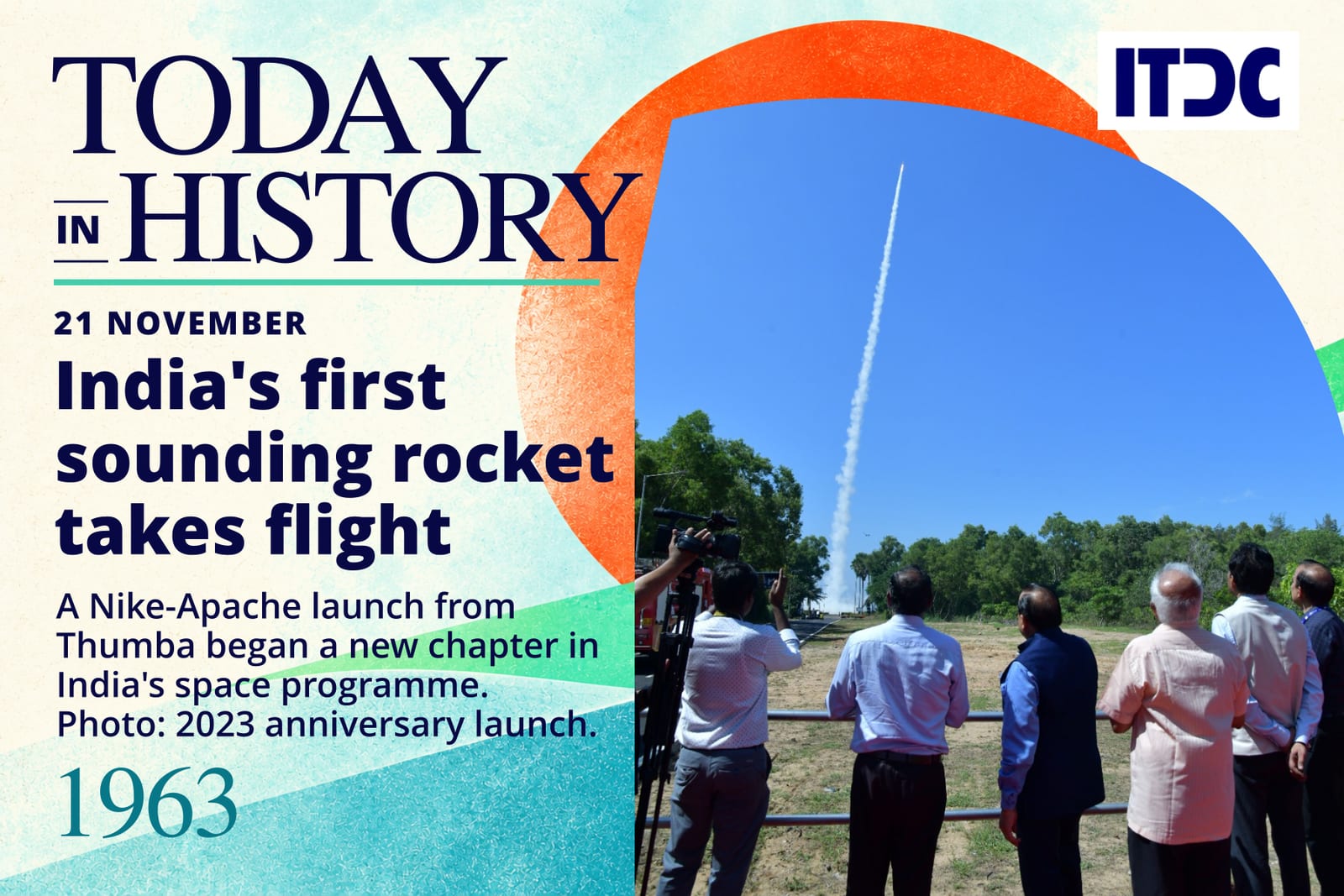
The photograph associated with this anniversary belongs to that later history. It shows a Rohini 200 launched during the diamond-jubilee commemoration at Thumba on 25 November 2023, rather than the Nike-Apache flight of 1963.
The significance of 21 November lies in the beginning of a sustained practice: asking scientific questions, building operational skills and developing increasingly capable equipment. India’s later achievements did not arrive fully formed. At Thumba, a short atmospheric flight helped establish the habits and expertise on which a much larger space programme could grow.
Hashtags: #TodayInHistory #Thumba #NikeApache #ISRO #Rohini #1963ThumbaSoundingRocket #ScienceTechnology #Kerala #1963TheSoundingRocket