


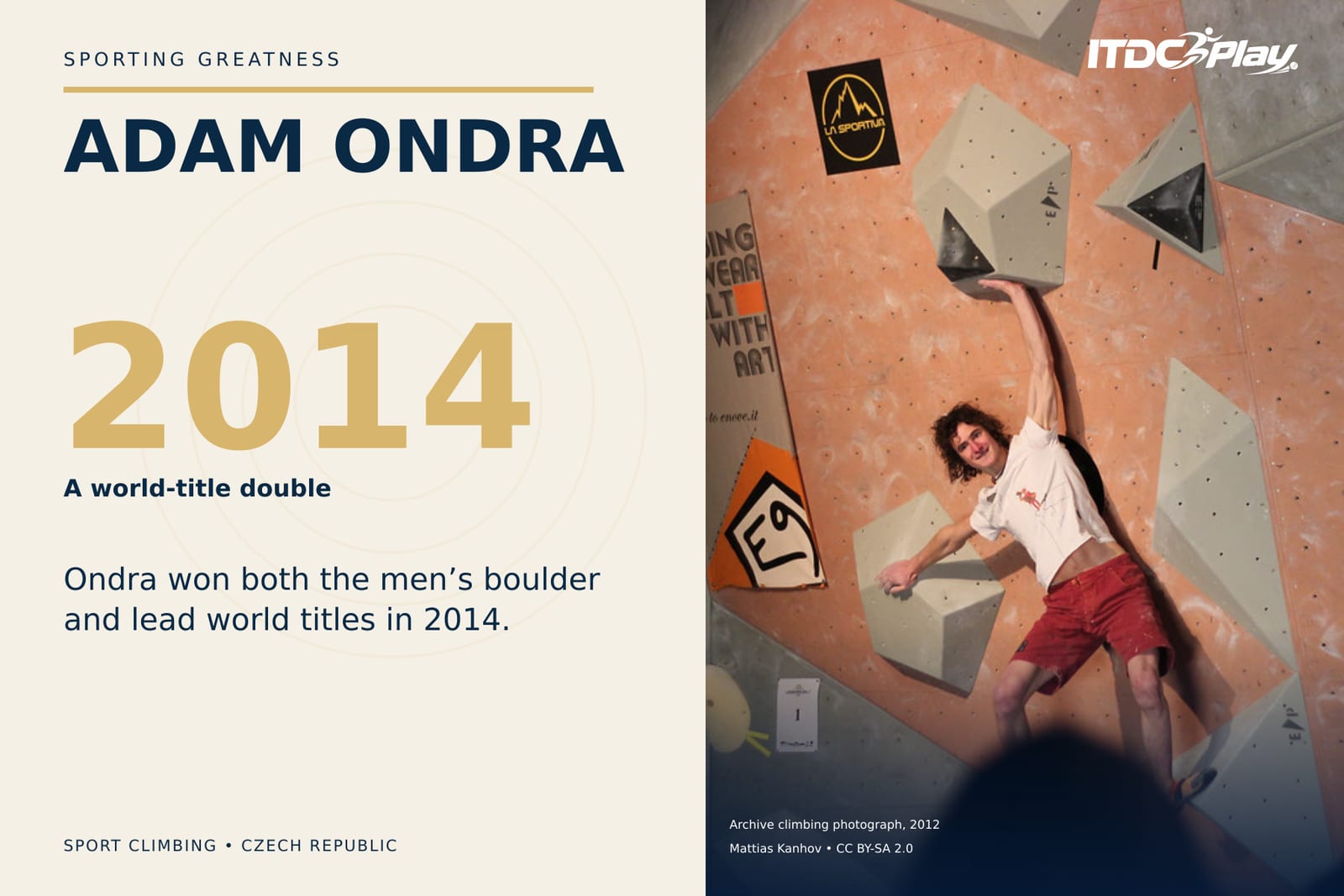
Mattias Kanhov / CC BY-SA 2.0
Munich / Gijón: Adam Ondra’s 2014 world championships required two cities and two distinct answers to the question of how to climb best. In Munich, Germany, he won the men’s boulder title on 23 August. In Gijón, Spain, he added the men’s lead title on 14 September. The Czech climber had turned a single season into a demonstration of exceptional range.
The distinction between the disciplines is central to the achievement. Boulder competition presents shorter, intensely difficult sequences climbed without a rope over protective mats. Athletes must work out movements and execute them within limited opportunities. Lead competition asks climbers to progress up a longer route while attached to a rope, with endurance and the management of effort increasingly important as the route rises.
Both demand strength, balance and technical judgement. They do not, however, reward precisely the same combination of abilities. A successful boulder attempt can depend on solving a concentrated movement puzzle; a lead performance also requires sustaining accuracy as fatigue builds. Winning both world titles means succeeding under two separate competitive tests rather than repeating the same task twice.
Ondra was 21 when he won in Munich. The International World Games Association recognised that performance by naming him its athlete of the month for August 2014. Its account placed the young climber from Brno within both competition climbing and the outdoor climbing world, where his ability was already widely recognised.
The second championship completed the season’s defining pairing. The international federation’s results record first place for Ondra in lead at Gijón, alongside first place in boulder at Munich. These were separate championship events, held weeks apart, not a combined Olympic competition decided by adding scores across disciplines.
That historical setting is useful for readers who first encountered climbing through the Olympics. Ondra’s double preceded the sport’s Olympic debut at the Tokyo Games. It belonged to the established world-championship circuit, with its own discipline titles and competitive history.
His achievement also challenges the idea that specialisation must always mean narrowing an athlete’s range. At the highest level, the differences between climbing disciplines are substantial. Ondra’s 2014 results showed that a climber could bring the necessary skills together while still respecting the demands of each event.
The enduring image is not simply of two gold medals. It is of two different walls, in different countries, requiring different solutions. Ondra solved both well enough to become world champion twice in the same year.



