CNN Central News & Network–ITDC India Epress/ITDC News Bhopal: The beating heart of a newspaper is not the small spine visible on its pages, but the sharp, piercing and sometimes painful vision that, under the guise of humor, holds a mirror up to society. At this unique cartoon event in the capital, pencils expressed far more than words. The live sketching sessions, exhibition, and discussions proved that a cartoon is not merely a joke—it is a medium of thought. Every line on stage carried a question, and every burst of laughter hid a deeper message.
This was the atmosphere on Friday at the Cartoon Show, Exhibition, and Live Demonstration organized at Makhanlal Chaturvedi National University of Journalism and Communication.
We lightly scratch the nerves of the mind with lines—laughter emerges, and so does thought. The heart of the newspaper beats louder when cartoons throw indirect truths into its quiet corridors. The distinguished cartoonists from across the country on stage delivered sharp yet sweet comments that made media students laugh and think at the same time.
Words and headlines build the structure of a newspaper, but cartoons are its beating heart. These were the remarks of the Vice-Chancellor of Makhanlal Chaturvedi National University of Journalism and Communication, Vijay Manohar Tiwari, during the inaugural session. He said cartooning is an integral part of newspapers and that media curricula must include subjects like cartooning. According to him, the art of cartoons will survive as long as human life exists, because drawings and lines speak volumes even beyond the limits of words.
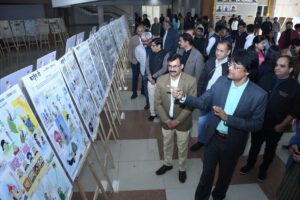
The exhibition, live demonstrations, and cartoon appreciation workshop proved that the art of cartooning is not only alive but is evolving within the changing media landscape and the challenges of social media. Students’ questions and the artists’ responses made it clear that the medium still holds the power to make society think while making it laugh.
Discussing the belief that cartoon art is shrinking across all forms of media, senior cartoonist Dr. Devendra Sharma said that today’s media has changed significantly. It is not entirely true that cartoon art is diminishing—people still want to see cartoons. Although there is less space for opinion in media today, with advertisements and market forces dominating, cartoon art continues to hold its place and adapt itself.
Echoing this point, noted cartoonist Hariom Tiwari said that cartoons contain both humor and satire. Today, cartoons are widely appreciated on social media and followed by large audiences. However, the nature of reactions on social media is making it increasingly difficult to create cartoons on sensitive subjects. Despite this, cartoonists continue to create humor and satire through their work.
Speaking about the changing nature of humor in the digital age, senior cartoonist Tryambak Sharma said that humor has taken new forms on platforms like social media, and our ways of thinking are evolving. With the increasing influence of AI in our lives, its impact on the art of cartooning is natural.
Discussing the role of cartoons in journalism, senior cartoonist Harimohan said that cartooning is the purest form of journalism. Most cartoons deal with political topics, he explained. Cartoonist Shirish Srivastava added that although politics remains a timeless subject for cartoonists, specific themes change according to current events.
Senior cartoon expert Prashant Kulkarni from Mumbai said that, from a cartoonist’s perspective, everything has an element of humor. Election seasons, too, provide abundant material for cartoon creation. Renowned cartoonist Ismail Lahri remarked that a cartoonist sees the world differently, with a unique perspective. This distinct observation is essential for creating effective and impactful cartoons. He emphasized that a cartoon is not just a joke—it is a serious artistic expression.
Senior cartoonist Govind Lahoti said that ideas continually flash through the mind of a cartoonist—it is a constant process. Senior cartoonist Madhav Joshi added that every artist contributes something to the world through their art. Cartoonists give people themes to think about through humor and satire conveyed via media.
All experts agreed that cartoonists can infuse life even into inanimate things. Cartoons are meant not only to amuse but to provoke thought. There is a cartoonist in all of us, and they have the ability to animate ideas.
At this unique cartoon show and live sketching event, several renowned cartoonists from across India participated, including Devendra Sharma, Tryambak Sharma, Prashant Kulkarni, Madhav Joshi, Harimohan Vajpayee, Chandrashekhar Hada, Abhishek Tiwari, Ismail Lahri, Kumar, Hariom, and Shirish. Senior journalist Shifali Pandey conducted the first session.
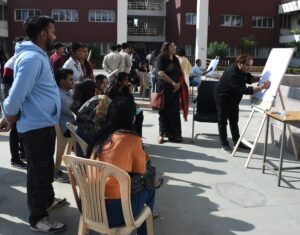
In the second session, all experts conducted live sketching on two burning topics—urban development and corruption—at the Takshashila and Vikramshila campuses at 2 pm. Students witnessed live sketching on diverse subjects and engaged in conversations with the artists.
A cartoon appreciation workshop was held in the concluding session. Senior cartoonist Prashant Kulkarni spoke about social cartooning. He explained how cartoons can be created on varied subjects and how topics for cartoons are selected. Kulkarni showcased famous cartoons made by noted artists from France, the UK, Germany, and India, and discussed their themes. He also covered many other related topics in detail. A Q&A session was organized for students. The workshop was conducted by Dr. Sandeep Bhatt.
A special exhibition featuring select, well-known cartoons created by these artists over the past three decades was also inaugurated.
Throughout the event, students’ enthusiasm surpassed even the remarkable presentations by the artists. When cartoonists drew live sketches on contemporary issues on the open-air stage, the session transformed into a real classroom. A flurry of questions, exchange of ideas, and direct interaction with artists created a learning environment unmatched by any textbook.
The live sketching on pressing topics such as urban development and corruption particularly challenged the students’ thinking, and the satirical lines appeared deeply connected to real life.
The event was coordinated by Professor Pavitra Srivastava, Head of the Department of Advertising and Public Relations. All university faculty members, students, and officials were present.
#MCU #CartoonShow #Exhibition #LiveDemo #ViceChancellor #UniversityEvent #MediaEducation #BhopalNews