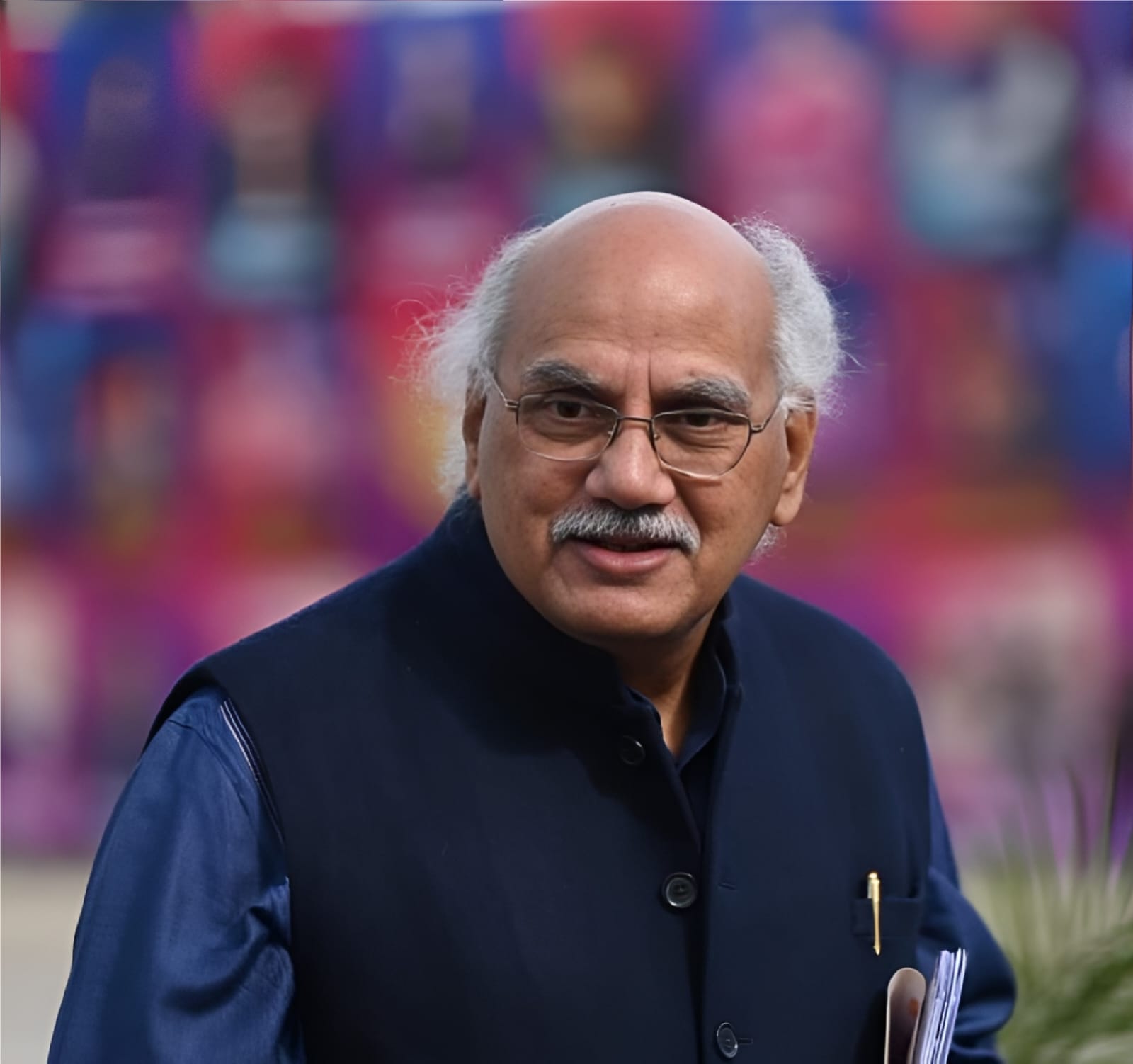
CNN Central News & Network-ITDC India Epress/ITDC News Bhopal: The core idea of Vishwarang is dialogue – creative and constructive dialogue between languages, cultures, arts and countries. Nalanda is not merely a historical place for this idea, but a living symbol.
India cannot be understood only through its political history. Our universities, gurukuls, libraries, journeys, languages, arts and traditions of knowledge exchange also shape the history of India. Nalanda has been an important centre of this intellectual and cultural history. Centuries ago, students and scholars came here from far and wide. Today, Vishwarang is bringing writers, educationists and artists from different languages, regions and cultural traditions onto one platform. Therefore, organising Vishwarang in Nalanda is not a repetition of the past, but a contemporary expression of that tradition of dialogue. This time, subjects such as language, translation, art, education and South Asia are seen together in Vishwarang’s programmes. What is the thinking behind this?
Santosh Choubey: India’s culture cannot be understood by dividing it into separate compartments. Language is connected with literature, literature with society, art with culture, and culture with our knowledge and worldview. That is why this time Vishwarang includes themes such as the shared ground of South Asian languages, Indian linguistic-cultural consciousness, languages of the eastern and northeastern states, translation, art, Nalanda’s knowledge tradition, universities of the future, and trade, culture and sustainable development with Southeast Asia. We want Vishwarang not to remain only a literary programme. It should become a platform where literature, art, education, language, technology, society and development establish a creative dialogue with one another.
What is Vishwarang’s biggest concern in the context of Indian languages? Santosh Choubey: We often speak of linguistic diversity, but diversity does not merely mean stating how many languages our country has. Every language carries within it a distinct world of experience, folk memory, history, literature and worldview. Therefore, saving Indian languages does not mean only preserving them, but increasing dialogue among them. I do not believe that the unity of Indian languages means their uniformity. Our strength lies in the fact that they maintain their distinctiveness while engaging with one another. This is where translation becomes very important. If a Hindi reader becomes familiar with literature in Assamese, Marathi, Tamil, Konkani or any other Indian language, he does not merely read a new book, but enters the experiential world of another society. Translation can become a strong foundation for cultural dialogue within India. Northeast India has been given a special place in this year’s deliberations. What is the reason for this?
Santosh Choubey: To see the Northeast only as India’s geographical frontier is to limit its cultural significance. It is a vast world of many languages, folk traditions, literary cultures and communities. Its historical and cultural links extend to Southeast Asia.
Therefore, to broaden Indian cultural discourse, it is necessary to bring the languages and literature of the Northeast to the centre. This is not an attempt to artificially bring any region into the mainstream, but an effort to make the very definition of our mainstream broader. The relationship between Vishwarang and Tagore has so far been an important part of its identity. How do you see Tagore in the context of Nalanda?
Santosh Choubey: It would not be appropriate to see Nalanda and Tagore in direct historical equivalence, but an important ideological thread is visible between the two – dialogue with the wider world while remaining rooted in one’s own cultural foundations. In Tagore’s vision, a deep sense of identity with one’s own culture and dialogue with other cultures go together. For this reason, Tagore appears in Vishwarang not only as a litterateur. His poetry, painting, theatre, music and thought are all part of our cultural discourse. This year in Patna, the Tagore painting exhibition, art seminar and discussion on his artistic vision are part of this wider context. When artificial intelligence and technology are changing the direction of education, what should we learn from Nalanda’s knowledge tradition?
Santosh Choubey: The question before us is more important than ever: what is the purpose of education? Is education only preparation for employment, or does it also give human beings the ability to think, question and understand society? The memory of Nalanda takes us beyond seeing knowledge merely as information. Reasoning, discourse, questioning and debate were important in knowledge. Today, when artificial intelligence and new technologies are bringing both new possibilities and challenges before us, we need universities that are multidisciplinary, dialogic and connected with society. The university of the future will be one where technology and the humanities, science and art, skill and thought are not opposed to one another, but are collaborators. Do you think the role of art and literature is declining amid the growing influence of technology?
Santosh Choubey: On the contrary, I think the role of art and literature is becoming even more important. We have discussed earlier as well that technology is increasing the pace of our lives, but it is also necessary to keep human sensitivities at the centre.
Today, artificial intelligence can do many things for us, but technology cannot by itself take the place of human experience, sensitivity, imagination and ethical questions. Therefore, the coming time is not one of increasing distance between science and art, but of increasing dialogue between the two. This year’s Vishwarang programme is quite extensive. What are its main features?
Santosh Choubey: This year, Vishwarang’s cultural journey is taking place at many levels. On October 3, guests will visit C.V. Raman University in Vaishali and interact with students, and there will also be a visit to the Vaishali Stupa. On October 4, programmes at Patna Museum will include the inauguration, cultural deliberations, the Tagore National Art Seminar, a museum visit, the Tagore painting exhibition and story readings. On October 5, the College of Art and Craft and Premchand Rangshala will host the Tagore children’s painting workshop, Lok Rang, a procession, folk singing and a theatrical presentation.
After this, dialogues in Nalanda will focus on knowledge, language, literature, art, education, translation and cultural relations with Asia. On October 7, discussions will be held on themes such as “Nalanda’s Heritage”, “The Shared Ground of South Asian Languages”, “Representation of Culture in the Arts”, “Translation: Language, Tradition and Development” and “Nalanda’s Knowledge Tradition and Universities of the Future”. On October 8, there will be sessions on Indian linguistic-cultural consciousness, languages of the Northeast, Buddhist philosophy in South Asia, trade-culture-sustainable development, and multilingual poetry readings. What message does Vishwarang want to give to the future India from Nalanda?
Santosh Choubey: Nalanda does not invite us to return to the past, but gives us an opportunity to move towards the future while engaging in dialogue with the past. We need an India that is modern technologically and economically, but is not cut off from its languages, literature, art and cultural memories. An India that sees diversity not as a problem, but as its strength. An India where universities are not merely institutions that award degrees, but centres of dialogue among different streams of knowledge. For me, this is also the meaning of Vishwarang – to remain connected with one’s roots while engaging in dialogue with the world. Nalanda’s greatest legacy is perhaps not in its buildings, but in the idea that knowledge travels, cultures engage in dialogue, and human beings expand themselves by understanding worlds different from their own. This is the core spirit of Vishwarang, and this should also be the basis of its journey ahead.
Hashtags: #MadhyaPradesh #Bhopal #Vishwarang #Nalanda #SantoshChoubey #IndianLanguages #Tagore #Culture #Education #VishwarangInNalanda