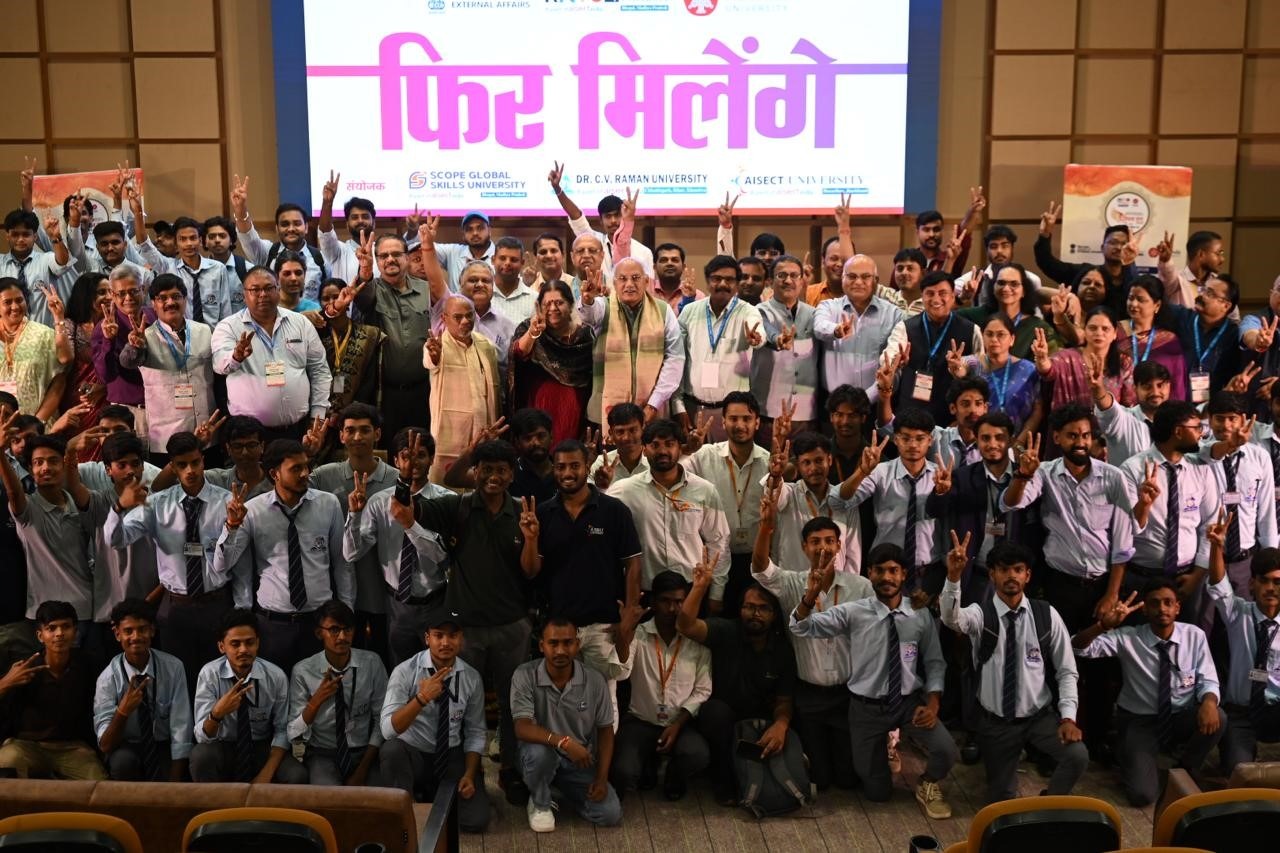
CNN Central News & Network-ITDC India Epress/ITDC News Bhopal: Bhopal/Nalanda. ‘Vishwarang Nalanda – 2026’, dedicated to global dialogue on Indian languages, literature, art and culture, concluded with six days of literary-cultural activities, intellectual deliberations and musical presentations.
Held in Patna and Nalanda, the festival saw extensive discussions on the Indian knowledge tradition, linguistic diversity, cultural interconnections, translation, folk traditions and India’s historical and cultural relations with South and Southeast Asia. At the inaugural ceremony held in Nalanda University’s grand auditorium, ‘Vishwa Mitralaya’, scholars, educationists, writers and cultural thinkers emphasised the need to take Indian languages and culture to the global stage.
Describing Vishwarang Nalanda as an event of historical significance, the inaugural ceremony was attended by Nalanda University Vice-Chancellor Sachin Chaturvedi, Vishwarang Director and Rabindranath Tagore University Chancellor Santosh Choubey, chief guest and Secretary, Ministry of Development of North Eastern Region, Government of India, K. Srinivas (IAS), keynote speaker and senior thinker Mukul Kanitkar, and Indian Council for Cultural Relations (ICCR) Deputy Director General Rajesh Ranjan, among several dignitaries. Nalanda University Vice-Chancellor Sachin Chaturvedi said it was a matter of pride that Vishwarang was being held at Nalanda and that the university had the opportunity to host it. He described it as an important occasion to carry forward the historic tradition of knowledge and culture.
Vishwarang Director Santosh Choubey said the search for the flow of cultures has been a key objective of Vishwarang. India’s culture is reflected in its languages, and Indian languages are the carriers of the country’s cultural heritage. Dialects give language flavour, vitality and a connection with people, and therefore the societies and communities associated with them must also be respected. He said Vishwarang is moving forward by bringing together Mahatma Gandhi’s idea of balanced development and Rabindranath Tagore’s international outlook. So far, diaspora Indian creators and foreign Hindi enthusiasts from more than 70 countries have joined the initiative. The platform is working to take Hindi, Indian languages, dialects, art, literature and culture to the global level.
Senior thinker and educationist Mukul Kanitkar said Nalanda represents the spirit of giving everything. He said holding Vishwarang in Nalanda’s Vishwa Mitralaya auditorium was a historic moment in itself. The festival, he said, was not merely a literary gathering but a resolve to build a happy, peaceful and knowledge-driven world. In the present time, he said, it is a moral responsibility to carry forward the Indian cultural ideals of ‘Vasudhaiva Kutumbakam’ and inclusiveness.
Chief guest K. Srinivas said the organisation of Vishwarang in Nalanda and the dialogue on language, literature, culture and arts in the context of Northeast India and Southeast Asia were extremely important. Nalanda has for centuries been a centre for the meeting of cultures and the exchange of knowledge. Vishwarang, he said, is taking this tradition forward with a new expansion. ICCR Deputy Director General Rajesh Ranjan also described the organisation of Vishwarang at Nalanda as unforgettable and underlined the need to share knowledge beyond borders through positive dialogue.
On the inaugural occasion, short films focusing on the seven editions of Vishwarang and the journey of Nalanda University were screened. Through these films, the effort to provide a wider platform to Indian art traditions and to highlight Nalanda’s global knowledge tradition was presented.
At a session on ‘Cultural Interconnections of South Asian Languages and Indian Languages’, speakers said the exchange of languages, literature and culture between India and various Asian countries has continued since ancient times. The session was chaired by Amarjeet Lochan of Nalanda University. Soma Bandopadhyay described comparative literature as an important medium to understand different languages and cultural traditions and stressed the need for wider research. D. Venkat Rao described the inclusive nature of Indian languages and the growing dominance of European languages over them as a major challenge.
Writer and translator Neetu Bajaj from Singapore highlighted the process through which Indian languages reached South Asian countries through migration, education and trade. Senior poet Arun Kamal said emotional similarities are visible in the poetry of Asian countries, but the study and introduction of Asian literature remain relatively limited compared with European literature. He underlined the need to understand the distinctive sensibilities and shared historical experiences of Asian literature.
Senior writer Janaki Prasad Sharma cited examples from the literary traditions of Sanskrit, Hindi, Persian and Urdu to underline the pluralistic nature of the Indian knowledge tradition. Jyoti Raghuvanshi, national coordinator of Vanmali Srijan Peeth and manager of AISECT Publication, said dialogue between languages must be increased and translation should be strengthened as an important medium for cultural relations.
At the session titled ‘Translation: Language Coordination, Tradition and Development’, experts discussed the growing need for translation not only in literature but also in technical education, law, health, agriculture, industry and skill development. The session was chaired by A. Aravindakshan, who stressed the need to increase cooperation between subject experts and translators. Special guest Bhushan Bhave said the need for translation has grown rapidly because of increasing movement between countries. Machine translation, he said, is emerging as a major market and is creating new opportunities for young people, but its use also requires an understanding of challenges related to creativity and the originality of language.
Indira Gandhi National Open University (IGNOU) Registrar and senior poet Jitendra Srivastava said translators have played an important role in the formation of different cultures and in establishing dialogue between them. Language and culture are deeply linked, and translation is a recreation of a work, he said. He also emphasised the need to translate material from various disciplines of knowledge and science.
Vishwarang Foundation Director and Rabindranath Tagore University Pro-Chancellor Aditi Chaturvedi Vats said translation should not be limited only to literature and book publishing. There are wide possibilities in the translation industry at the global level. Along with encouraging translation among Indian languages, content should also be made available through mediums such as e-books and audiobooks. She said that despite the growing use of machine translation, the role of language and subject experts will remain important.
Jyoti Chawla of the Centre for Translation Studies, IGNOU, Delhi, described translation not merely as a linguistic activity but as a process linked to cultural and political perspectives. Jawahar Karnawat, Director of the Tagore International Hindi Centre, said the demand for translation is increasing internationally and that it is an important medium of global dialogue.
A session on ‘Economic-Cultural Consciousness of the Northeast and Southeast Asian Countries’ was chaired by Nalanda University Vice-Chancellor Sachin Chaturvedi. S.K. Mohanty, Sudhanshu Kumar, P.K. Biswas, Mary Bal, Iman Kalyan Lahiri and Kishor Dhawala spoke on different dimensions of regional relations. Speakers said Northeast India is geographically the gateway to Southeast Asia as well as an important link in cultural exchange. Regional development can be given a new direction by connecting shared historical memories, folk traditions, linguistic diversity and cultural similarities with economic cooperation. Special emphasis was placed on inclusive development, trade cooperation, tourism and strengthening people-to-people contact.
At the session titled ‘Nalanda’s Knowledge Tradition and Future Universities’, chaired by Scope Global Skills University, Bhopal, Chancellor Siddharth Chaturvedi, the focus was on imagining the universities of the future through Nalanda’s knowledge tradition. Chaturvedi said drawing on Nalanda’s knowledge tradition to conceptualise future universities gives new energy. Referring to environmental protection, he said that if more than 1,400 universities in the country drew inspiration from Nalanda University’s net-zero carbon campus and developed their campuses on a net-zero model, a significant reduction in carbon emissions could be achieved. He called for making a multidisciplinary approach, a transparent examination system and critical thinking key foundations of future universities in line with the National Education Policy.
Scope Global Skills University, Bhopal, Vice-Chancellor Vijay Singh spoke about the concept of industry-integrated education. He said students are being provided practical experience, apprenticeship and internship opportunities through partnerships with industries, anchor partners and centres of excellence. By providing an industry-like work environment on campus, students can develop practical skills during their studies and prepare better for employment. Rajeshwar Kumar, Pallav Tiwari, Kishore Kumar Tangavelu and Abhishek Pandit also expressed their views in the session.
Under Vishwarang Nalanda, the programmes held in Patna had Patna Museum and Premchand Rangshala as major centres. At Patna Museum, deliberations were held on various aspects of Indian culture, South and Southeast Asian cultural consciousness, art and literature. Eminent writer and former diplomat Pavan K. Varma, along with writers, artists and cultural thinkers, spoke on Indian cultural heritage and the possibilities of dialogue among Asian societies.
At Premchand Rangshala, folk songs and folk dances were presented, along with the staging of plays written by Santosh Choubey, ‘Unke Hisse Ka Prem’ and ‘Lekhak Banane Wale’. These presentations expressed Indian folk life, social sensitivities and the rich tradition of theatre.
Among the cultural presentations of the festival, the performance by renowned Rabindra Sangeet singer Shrikant Acharya and his associates was a special attraction. Songs based on the works of Rabindranath Tagore, expressing love, separation, nature and human emotions, captivated the audience. The melodious combination of vocals and instruments filled the auditorium with an intimate and emotional atmosphere. During the performance, the audience warmly applauded the artists.
Vishwarang Nalanda – 2026 conveyed the message that Indian languages and culture are not only the heritage of the country but also an important foundation for dialogue, cooperation and shared cultural consciousness among various societies of Asia. Organised on the land of Nalanda’s historic knowledge tradition, the festival emerged as an important initiative towards connecting Indian languages, literature, art and culture with South and Southeast Asia.
Vishwarang – 2026 was organised jointly by C.V. Raman University, Vaishali, Vishwarang Foundation and Nalanda University, Nalanda. On the occasion, C.V. Raman University, Vaishali, Registrar Brijesh Singh said Nalanda and Vaishali are two important lands of Indian history and the knowledge tradition. Through Vishwarang Nalanda, the academic and cultural dialogue established between the two will become the basis for new partnerships in the future and give a new direction to the wider spread of Indian languages and culture.
Hashtags: #VishwarangNalanda #IndianCulture #NalandaUniversity #IndianLanguages #SouthAsia #SoutheastAsia #VishwarangNalanda2026 #VishwarangFoundation #Translation #RabindraSangeet