CNN Central News & Network-ITDC India Epress/ITDC News Bhopal: Neutrinos are among the most elusive particles known to science. These extremely light, electrically neutral subatomic particles interact very weakly with ordinary matter, allowing enormous numbers of them to pass through the Earth and the human body almost unnoticed. Their unusual behaviour has earned them the nickname “ghost particles.”
Neutrinos belong to the same broad family of fundamental particles as electrons, but unlike electrons, they carry no electric charge. Scientists have identified three types, or “flavours” — electron, muon and tau neutrinos. They can also change from one flavour to another as they travel, a phenomenon known as neutrino oscillation.
The nickname “ghost particles” comes from their extraordinary ability to pass through matter. Neutrinos interact so rarely with atoms that trillions can travel through our bodies every second without producing any noticeable effect. Their lack of electric charge also means they are not deflected by magnetic fields, allowing them to travel enormous distances relatively undisturbed.
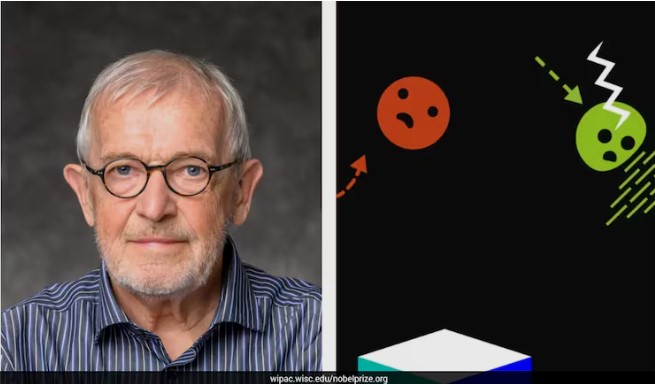
This elusive nature is central to the work of physicist Francis Halzen, who received the 2026 Nobel Prize in Physics for decisive contributions to the IceCube Neutrino Observatory and the discovery of high-energy neutrinos of astrophysical origin.
Halzen proposed using the clear ice beneath the South Pole as a giant neutrino detector. IceCube contains thousands of light sensors embedded deep inside Antarctic ice. When a neutrino very rarely interacts with matter, the resulting particles can produce a tiny flash of light, which the sensors detect and analyse to estimate the neutrino’s direction and energy.
Because neutrinos can travel from distant cosmic sources without being easily absorbed or deflected, they act as valuable messengers from the universe. IceCube has helped scientists study high-energy phenomena and opened a new way of investigating some of the most extreme environments in space.
Hashtags: #ScienceTechnology #Bhopal #What #Are #Neutrinos #Why #They #Called #Ghost #WhatAreNeutrinosAnd