ITDC illustration
Lift the film from a cup of hot milk and it comes away like a sheet. Leave the surface undisturbed, and another may form. Where does that skin come from when the milk beneath it is still liquid?
Milk is a mixture, not just water with a white colour. It contains proteins, fat droplets and other dissolved or suspended material. Heating changes the behaviour of some proteins, unfolding their structures and allowing them to associate in new ways.
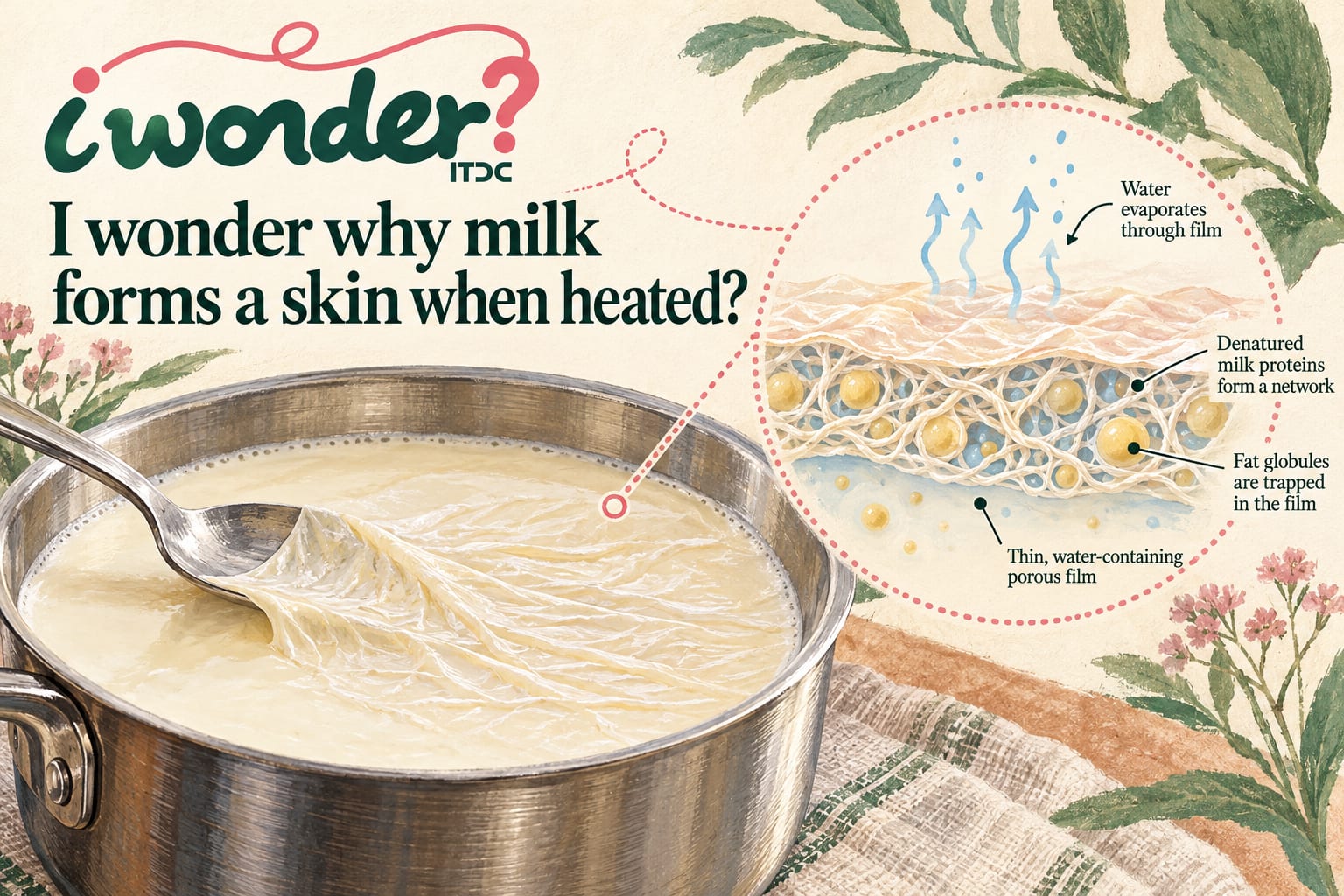
Evaporation removes water while proteins and fat become concentrated. A thin film develops containing a network of altered proteins and trapped fat globules. The skin therefore has more structure than the liquid below, even though it still contains water.
It is tempting to identify the entire sheet as cream. Fat is involved, but the film is not simply a layer of pure fat that has floated upwards. The protein network helps explain why it can stretch across the cup and be lifted as a connected piece.
Formation is only part of the story. The skin may also wrinkle as it sits on the milk. Researchers studying heated milk have described the film as a thin, porous material through which water can move and evaporate. Those flows can create stresses that buckle the surface.
A smooth sheet can thus become a landscape of ridges without anyone touching it. The pattern reflects the behaviour of the film and the liquid beneath, as evaporation continues across the surface.
Its appearance depends on the milk and on heating, evaporation and disturbance. A moving surface does not behave exactly like one left quietly exposed to air.
The film that interrupts a sip is a visible boundary between two environments: liquid milk below and air above. At that boundary, escaping water and changing proteins build a delicate structure.
Hashtags: #IWonder #Milk #FoodScience #ScienceTechnology #India #Why #Does #Form #Skin #When