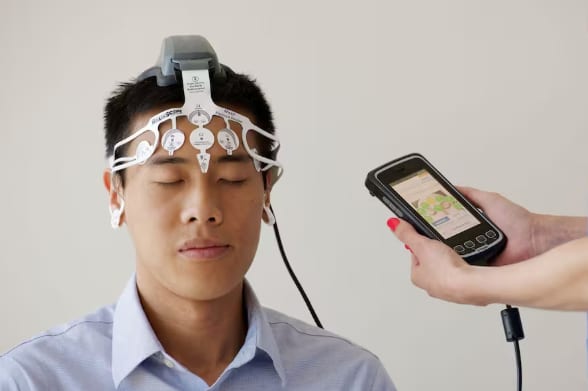
CNN Central News & Network-ITDC India Epress/ITDC News Bhopal: For people who have lost the ability to speak because of paralysis or neurological disease, brain-computer interfaces (BCIs) are emerging as a new source of hope. The technology works by converting signals received directly from the brain into words that can be understood by a computer. Recent research has demonstrated the use of a single brain implant to interpret speech and hand and facial gestures at the same time.
How does this technology work?
Through surgery, electrodes are placed over the part of the brain where signals linked to speech and body movement are generated. When a person tries to speak, even if their voice cannot be produced, the implant records those neural signals. Machine learning and artificial intelligence then identify patterns in these signals and convert them into words, text or a digital voice.
In the new research, scientists recorded activity in the sensorimotor cortex using a high-density implant with 253 electrodes. Along with speech, the system also interpreted signals for nodding, hand movement and other gestures, converting them into text on a screen and movements of a digital avatar.
In another 2026 study, a paralysed person used a BCI at home for nearly two years and communicated the equivalent of more than 1.96 million words. However, the technology is still in its early and research stage, with challenges including surgery, personalised training and safety.
Wireless technology is another important step in this direction. In June 2026, a wireless BCI was implanted in a human for the first time at the University of Michigan, with the aim of developing a long-term communication system for patients who have difficulty speaking.
Hashtags: #Health #Bhopal #Desksource #WirelessBrainImplant #BCI #Paralysis #DeskSource #BrainComputerInterface #NeurologicalDisease #DigitalVoice