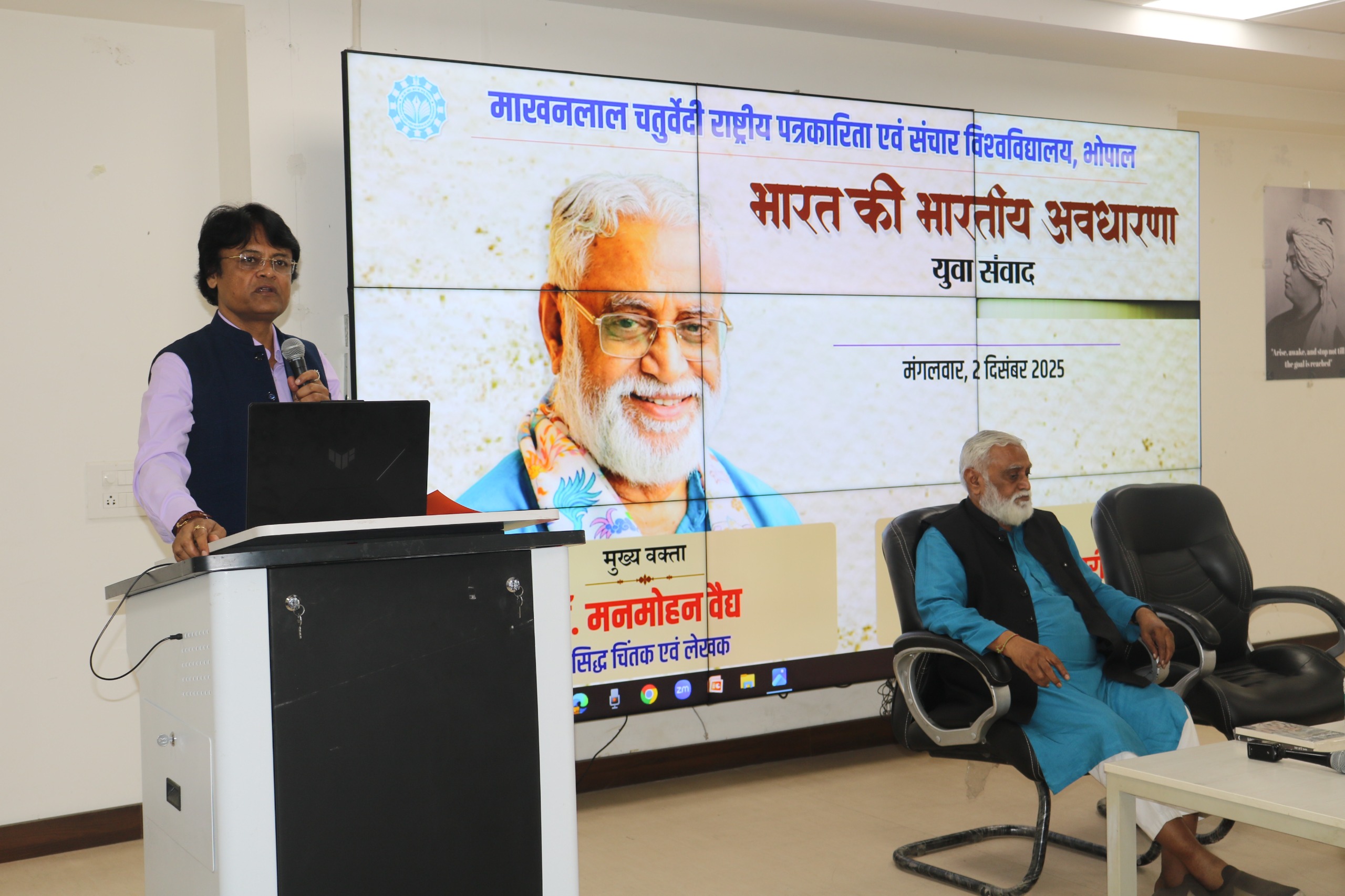
CNN Central News & Network–ITDC India Epress/ITDC News Bhopal: Bhopal. Renowned thinker Dr. Manmohan Vaidya, explaining the Indian concept of India, said that the word “Rashtra” does not mean “Nation.” India never had a single king or a single language, yet from the north to the south, society remained unified through the core values of spirituality and culture. This is what shaped the Sanatan Rashtra. This society was not dependent on the state; it was a self-sustaining, indigenous society.
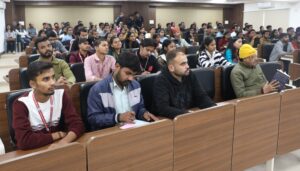
Dr. Vaidya was addressing a Youth Dialogue organized at the Makhanlal Chaturvedi National University of Journalism and Communication (MCU). The event was jointly organized by the Students’ Study Circle and the Department of Journalism. The program was chaired by Vice-Chancellor Vijay Manohar Tiwari. Recently, Dr. Vaidya’s book “Hum Aur Yah Vishva” was published and launched in the capital a few days ago.
Dr. Vaidya said that Indian society was completely self-reliant; it did not import but exported goods. India had almost two-thirds of the world’s trade share, more than Britain and America combined. Enterprises existed in every household. Women played an extraordinary role in industry. Our homes were centers of wealth generation, which is why homemakers were regarded as Grihalakshmi. He emphasized that abundance in production, equality in distribution, and restraint in consumption define the Indian economic thought.
Dr. Vaidya further stated that India does not have “cultural diversity”; rather, one culture expresses itself in diverse forms. Spirituality has shaped the Indian worldview. India has always thought of the welfare of the world. Criticizing the defeated mindset, he said that since 2014, the world has once again begun listening to India. The Sunday Guardian wrote in an editorial that India has rediscovered its independence.
Responding to a question, he said that Dharma is an Indian concept that has no real English equivalent. In India, Dharma has held a broad meaning—returning something to society for the welfare of all was considered Dharma. India walked the path of Dharma. The mottos of our major institutions, including the Lok Sabha, are derived from Dharma. The Ashoka Chakra in the national flag is actually the Dharma Chakra, established by Emperor Ashoka. He added that “secularism” is not an Indian term; it was coined in the West after the church’s interference in governance. In 1976, it was added to the Indian Constitution without any debate. He clarified that the state must work above religion, but an individual cannot be “secular” in the Western sense.
On this occasion, Vice-Chancellor Vijay Manohar Tiwari said that Dr. Vaidya’s thinking and writings clarify what India truly is and what perspective is needed to understand it. Journalism is the art of viewing the world from 360 degrees, and the university nurtures this vision. Discussing Hum Aur Yah Vishva, he said it offers a completely new perspective on Allama Iqbal’s “Hum bulbulen hain.” Dr. Vaidya added that when the garden faces a crisis, birds fly away, and plants may burn, but they do not leave the garden. We are the plants of this garden.
The program was conducted by student Rajvardhan Singh.
#MCU #YouthDialogue #IndianConceptOfIndia #NationalIdentity #CulturalDiscussion #UniversityEvent