


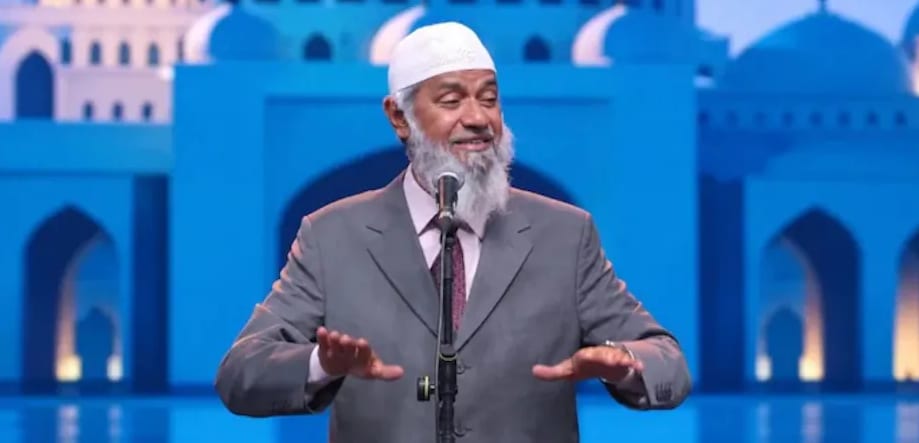
CNN Central News & Networks / ITDC India ePress / ITDC News /Agencies/ Bhopal: New Delhi. Controversial Islamic preacher Zakir Naik has come under criticism after defending the Taliban’s restrictions on girls’ education in Afghanistan. Journalists, social activists, educationists and intellectuals from India, Pakistan and Afghanistan have objected to his statement. Critics say an indefinite ban on girls’ education cannot be justified by describing it merely as a temporary delay.
What did Zakir Naik say? In a video, Zakir Naik claimed the Taliban has not imposed a permanent ban on girls’ secondary and higher education, but has deferred it because of security concerns and a shortage of women teachers. He said girls are allowed to study up to Class 6, and authorities are waiting for a safe environment and enough women teachers for further studies. Naik also claimed women in Afghanistan are studying up to postgraduate and PhD levels in subjects such as Islamic studies, Arabic and the Quran. He said not every piece of information in the media is correct and that he has spoken to Taliban representatives on the issue.
Malala’s father expresses anger: Ziauddin Yousafzai, father of Nobel Peace Prize winner Malala Yousafzai and a Pakistani education activist, described Naik’s arguments as disappointing and worrying. He said it is not appropriate to describe an indefinite ban as only a delay in education. He asked that if there is a shortage of women teachers, how can the number of educated women teachers be increased in the future by stopping girls from studying.
Maryam Soleimankhil, linked to Afghanistan’s parliament-in-exile, and other Afghan commentators also questioned Naik’s statement. They argued that when education and employment opportunities for women are being restricted, citing a shortage of women teachers as the basis for the ban is contradictory.
United Nations figures also raise concern: According to the United Nations Children’s Fund (UNICEF), more than 2.6 million Afghan girls have been deprived of secondary education since the Taliban returned to power. Since September 2021, formal education for girls beyond Class 6 has been banned, while in December 2022 women were also barred from entering universities. As a result, Afghanistan remains the only country in the world where secondary and higher education for girls and women is effectively closed.
Questions raised in India as well: Indian Islamic scholar A. Faizur Rahman tagged Malaysian Prime Minister Anwar Ibrahim and asked why Zakir Naik receives wide support there. Others, including historian S. Irfan Habib, also criticised his remarks. Zakir Naik left India in 2016 and moved to Malaysia. In India, he faces cases linked to various allegations, including money laundering and promoting religious enmity, which he has continued to reject. The controversy has once again intensified the international debate over girls’ right to education in Afghanistan and the Taliban’s policies.
Hashtags: #WorldInternational #Bhopal #GirlsEducation #Taliban #ZakirNaik #Afghanistan #Girls #Education #Defence #Controversy



