


ITDC illustration
Rinse an oily plate with plain water and the oil often stays put. Add some soap, rub the surface and rinse again, and the plate feels different. Water has not developed a taste for grease. Soap has changed how the two can meet.
A soap molecule has two useful parts. One end interacts readily with water; the other is a long tail that mixes more comfortably with oily material. Chemists call these parts hydrophilic and hydrophobic, meaning water loving and water avoiding. These are convenient descriptions of molecular behaviour, not preferences or decisions.
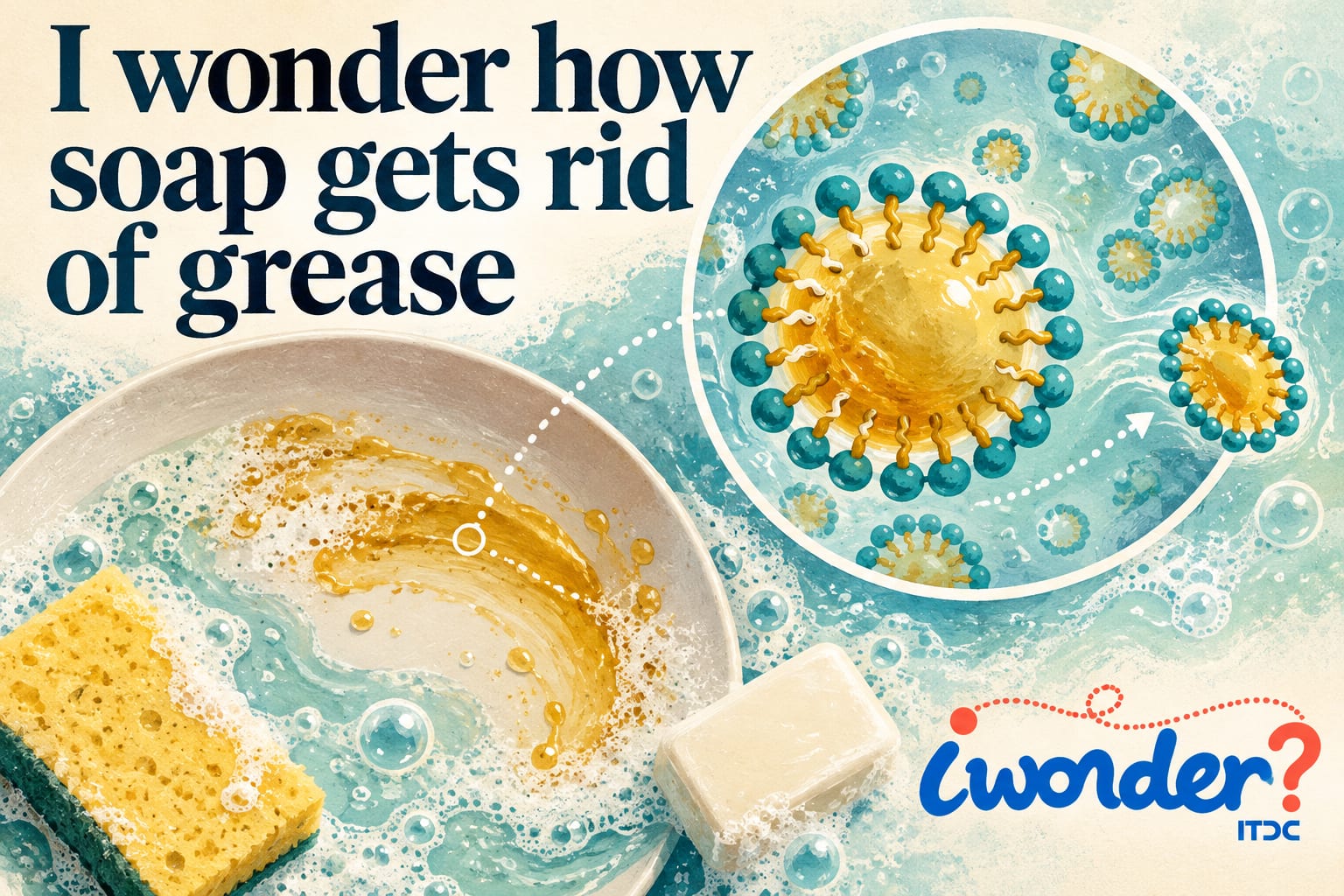
At the boundary between grease and water, soap molecules can arrange themselves with their tails in the grease and their heads facing the water. Rubbing helps detach and break up the oily layer. The soap helps keep the resulting oily material dispersed so that the rinse water can carry it away.
Soap molecules can also gather into clusters called micelles. Their tails point inward, away from the water, while their heads face outward. Oily substances can be accommodated inside these clusters. This is one part of the cleaning process, alongside loosening dirt and helping water wet a surface.
The grease has not vanished or been magically destroyed. Much of it has simply moved from the plate into the wash water. That is why rinsing is an essential part of the sequence.
Water chemistry can complicate matters. In hard water, calcium and magnesium can react with ordinary soap to form insoluble material, often noticed as scum. Many synthetic detergents are designed to avoid this problem while still having parts that interact with water and oil.
The washing up is therefore a small exercise in molecular matchmaking. Soap provides a meeting point for substances that ordinarily separate, then helps the water take the unwanted grease along when it leaves.



