


ITDC Roots
The border of a Maheshwari sari is a useful place to begin looking. Its narrow bands may contain a wave, a pattern recalling woven matting, or a small cotton flower. These designs have names: leher, chatai and rui phool. Knowing them turns a decorative edge into a vocabulary that weavers and wearers can share.
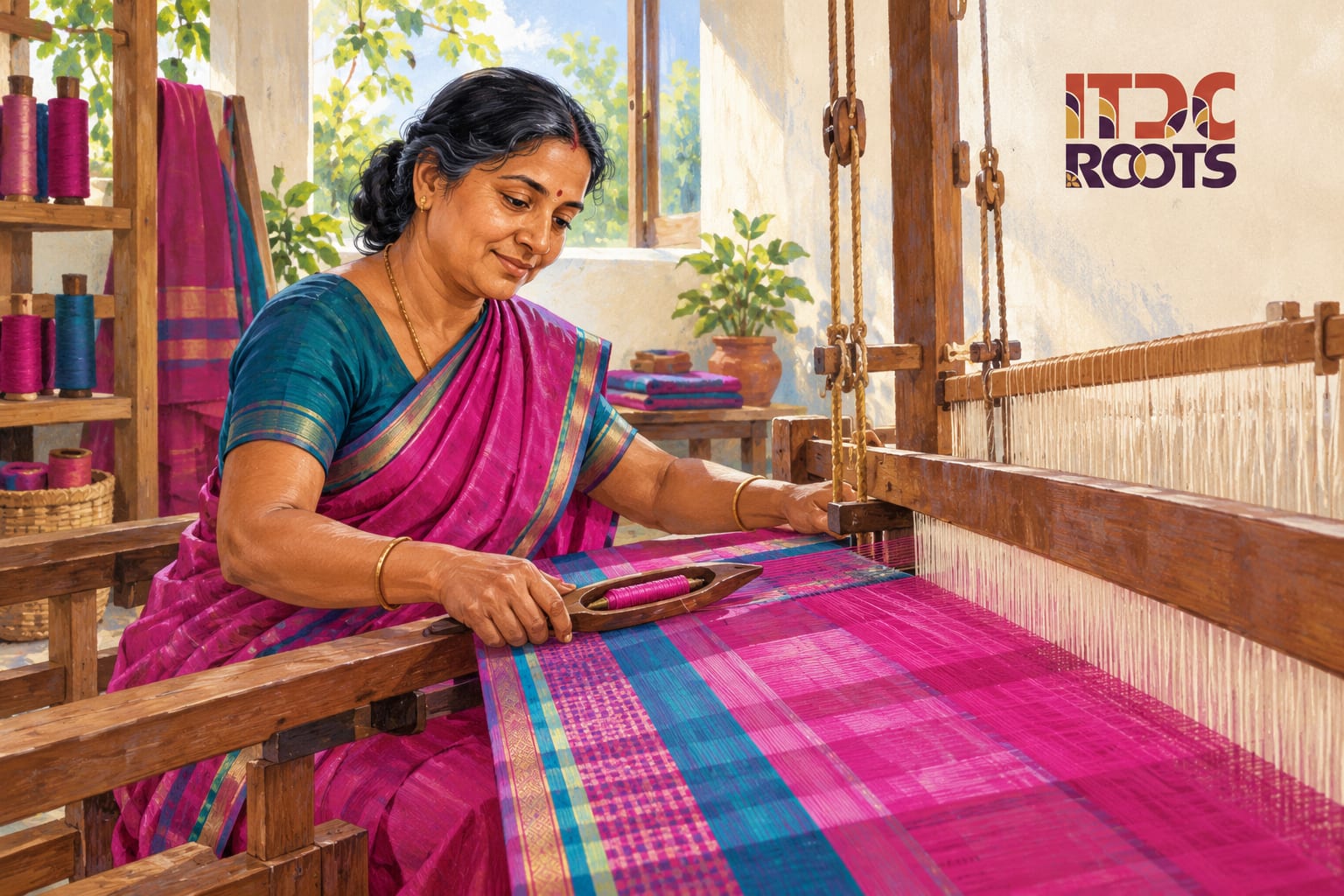
Maheshwari cloth is associated with Maheshwar on the Narmada and with the patronage of Ahilyabai Holkar. Yet its character is best understood through the loom rather than a royal origin story alone. A common construction combines silk in the warp with cotton in the weft, bringing sheen and lightness into the same fabric. Checks, stripes and the arrangement of the pallu depend on how those threads are planned and crossed.
Craft documentation identifies the border as a distinguishing feature of the sari. Some designs are reversible, allowing the pattern to read from either side. That quality is made within the weave; it is not a second decoration attached to the reverse. The edge has to remain coherent while the main field continues beside it.
The survival of this knowledge has also required new forms of organization. In the late nineteen-seventies, Richard and Sally Holkar established the initiative that became REHWA Society. Its own account remembers women learning at looms under master weaver Ganesh Bichwe and his family. Training and employment, not simply admiration for old textiles, were central to that effort.
Maheshwari weaving now encompasses different fibres, colours and products, so no single sari represents everything made in the town. The named patterns nevertheless offer a precise way of noticing continuity. A chatai border translates the interlacing associated with a mat into another woven structure. A rui phool recalls the cotton plant while the cloth itself may contain cotton. Small details carry the craft’s material intelligence.



