


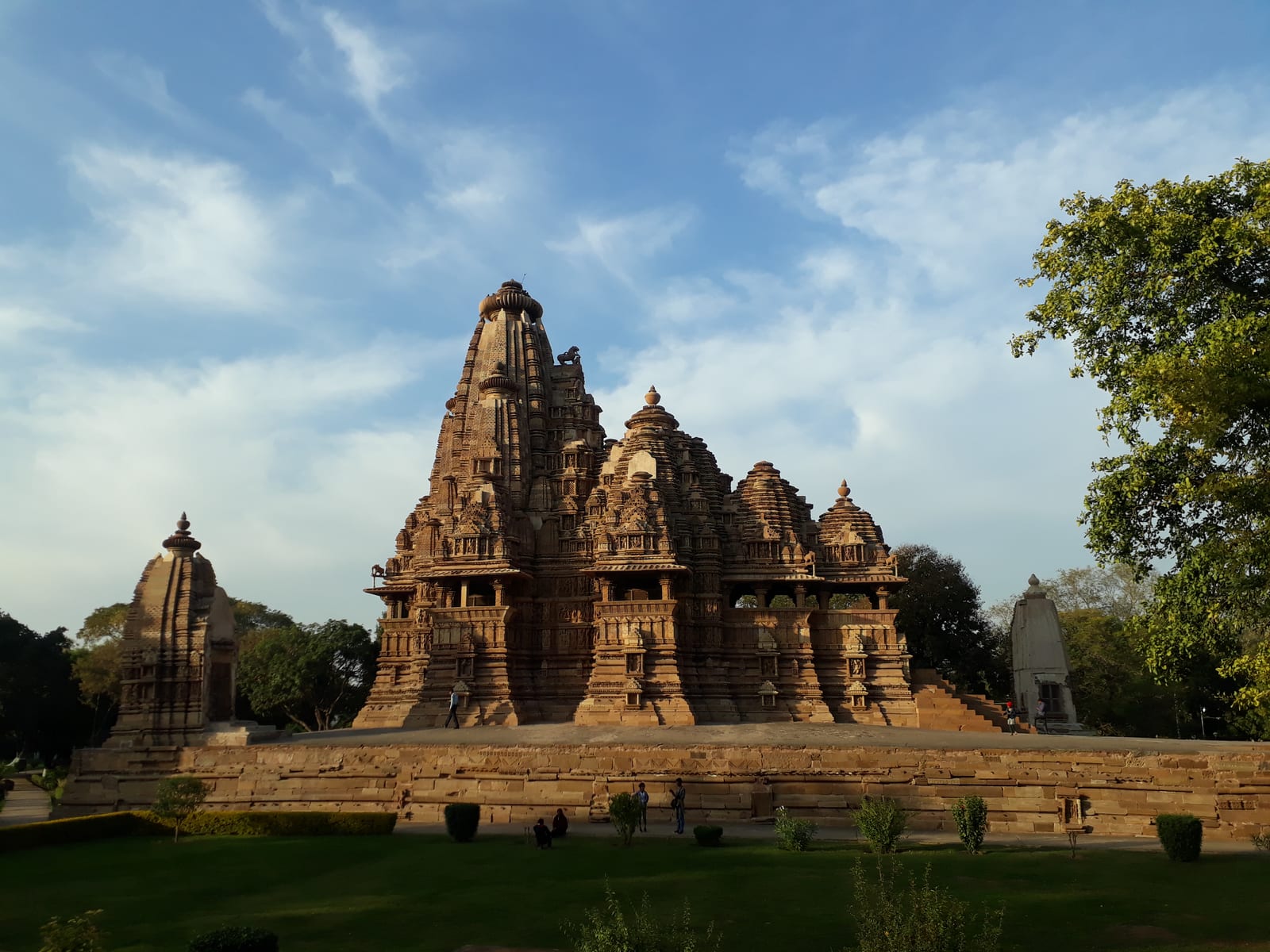
Kandariya Mahadeva’s silhouette can be read from front to back. The roofs rise in stages, gathering around the tall tower above the sanctum. Smaller spires repeat its shape at different heights. What first appears to be a dense cluster is an organized ascent, giving the most sacred chamber the strongest presence on the skyline.
This relationship between plan and elevation is central to the temple at Khajuraho. An entrance porch leads into halls, followed by a connecting vestibule and the garbhagriha, or sanctum. The sequence draws movement along an axis. Outside, the changing roof heights make that inward progression visible from a distance.
A historical architectural drawing preserved by the Indira Gandhi National Centre for the Arts records another space: the passage surrounding the sanctum. This circumambulatory route allows movement around the sacred centre. The temple therefore accommodates both an approach towards the deity and a circuit around that presence. Its architecture organizes worship through space.
The projecting and receding surfaces also give the sculpture its setting. Figures occupy a building whose walls change direction, so their appearance alters as someone moves around it. The raised platform separates this articulated stone body from the ground, while the miniature spires carry its visual rhythm upwards. The sculpture and the tower belong to the same composition.
Kandariya emerged from the Chandella building tradition of the tenth and eleventh centuries. UNESCO’s account of Khajuraho emphasizes the integration of architecture and sculpture, a useful corrective to viewing individual carvings in isolation. Here the larger form deserves as much attention as any celebrated detail.
The building’s repeated shapes lead the eye to one dominant summit. Below it lies the compact sanctum, concealed by the mass surrounding it. That correspondence between a small interior focus and an expansive exterior is one of Kandariya’s compelling architectural achievements.




