


ITDC illustration
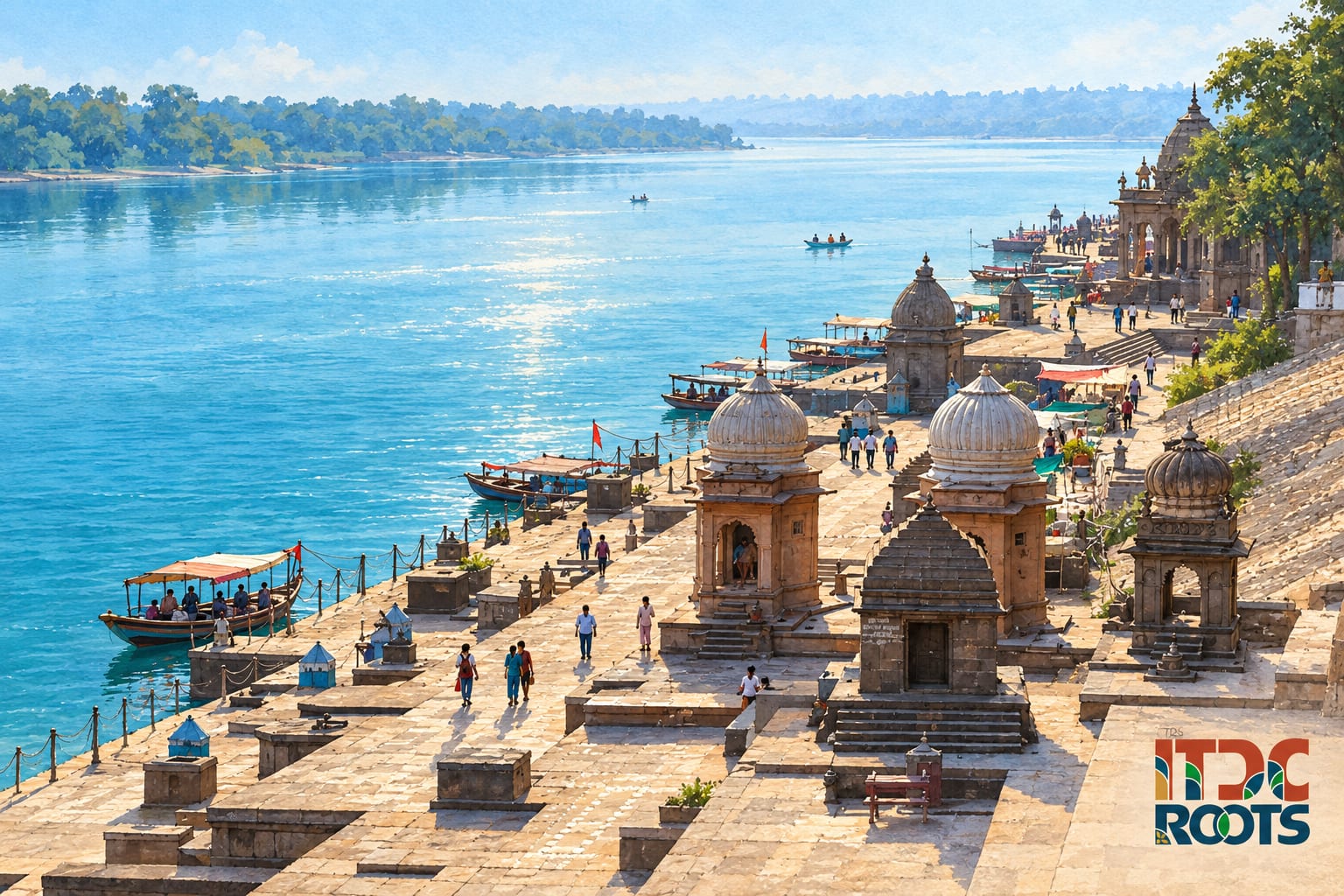
Maheshwar’s riverfront is closely associated with Ahilyabai Holkar, but its skyline contains buildings raised after her death. The steps, gateways and memorial shrines below the fort record a longer process of construction. Recognizing those layers gives the Narmada panorama a precise history.
Ahilyabai made Maheshwar her capital in the eighteenth century. Her palace above the river became a centre of administration and devotion. The descent towards the water connected that elevated courtly setting with the ghats, where access to the Narmada remains central to the town’s religious life.
Among the later additions is the Ahilyeshwar memorial shrine. A government handicraft survey published with the 1961 Census recorded an inscription identifying a building campaign begun by Yeshwant Rao Holkar in 1799 and completed under Krishnabai in the nineteenth century. The monument commemorates Ahilyabai; its association with her should not be mistaken for construction during her lifetime.
The same survey describes the flight of steps rising from the river towards the carved shrine, which contains a Shiva lingam and an image of the queen. Nearby stands the memorial to Vithoji Holkar. Together, these structures turn the riverfront into a setting where dynastic remembrance and worship occupy adjoining spaces.
Their architecture also helps explain the panorama’s changing scale. From the water, the stepped bank and high walls form a continuous frontage. Moving upwards, that apparent unity resolves into gateways, separate courts and individual shrines. The ascent reveals distinctions that the distant view compresses.
Maheshwar’s identity therefore rests partly in how successive generations built around the memory of an earlier ruler. The fort, palace and memorials belong to a connected setting without belonging to one moment. Looking across the Narmada, it is possible to admire the whole composition while remembering that its recognizable elements preserve different episodes in the town’s history, one above another.



